

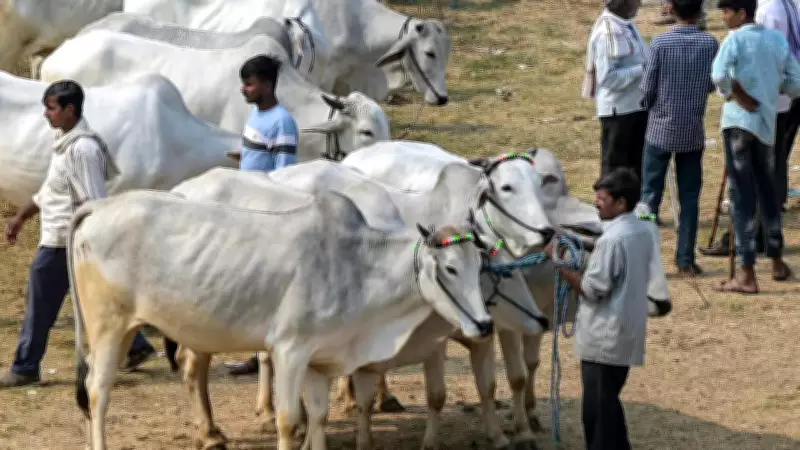
The Calcutta high court on Thursday declined to intervene in the West Bengal government's notification that restricts the slaughter of bulls, bullocks, cows, calves, and buffaloes ahead of Bakr Eid next week. A division bench comprising Chief Justice Sujoy Paul and Justice Partha Sarathi Sen observed that the notification was issued in compliance with earlier court directives. The bench noted that the order passed by a coordinate bench in WP 328 of 2018 has attained finality, leaving no basis to stay or set aside the public notice dated May 13, 2026. Consequently, the petitions concerning this notice were dismissed.
The court referenced a Supreme Court ruling that the sacrifice of cows is not an essential part of the Id-Uz-Zuha festival and is not a mandatory religious practice under Islam. The bench stated, 'We find no difficulty in directing the State to consider amendment of the impugned notice by inserting aforesaid two conditions forthwith. We order accordingly.'
However, the court acknowledged that the state government is empowered under Section 12 of the West Bengal Animal Slaughter Control Act to decide on exemptions sought by certain petitioners. Given that the festivals may occur on June 27 or 28, the court ordered the state to make a decision within 24 hours of receiving the order.

The ruling came during a hearing on a batch of petitions challenging the guidelines issued under the West Bengal Animal Slaughter Control Act ahead of Bakr Eid (Eid al-Adha). While refusing to interfere with the notification, the court observed that the state should examine whether an appropriate mechanism exists for issuing necessary certificates for animal slaughter under the Act and Rules. The bench added, 'In addition, whether responsible officers are in place in the State for issuing such certificate and whether the necessary infrastructure is at place in the entire State where slaughter can take place. If any deficiency is found by the State, we hope and trust that same shall be cured at the earliest.'
The public notice issued on May 13 mandates that bulls, bullocks, cows, calves, and buffaloes cannot be slaughtered without a certificate declaring them unfit. It states, 'No person shall slaughter any animal thereby meaning (bulls, bullocks, cows, calves, male and female buffaloes, buffalo calves and castrated buffaloes) unless he has obtained in respect thereof a certificate that the animal is fit for slaughter.'
A joint certificate for animal slaughter can only be issued by the chairman of a municipality or the sabhapati of a panchayat samiti along with a government veterinary surgeon, provided both agree that the animal is over 14 years of age for work or breeding or has become incapacitated due to age, injury, deformity, or incurable disease. Authorities must record their opinion in writing, and applicants may appeal within a fortnight if a certificate is denied.
The state government issued the order under the West Bengal Animal Slaughter Control Act, 1950. Slaughtering of animals with a certificate is prohibited in any open public place, and violations may result in up to six months' imprisonment, a fine of Rs 1,000, or both. Earlier, the state directed police to adopt a zero-tolerance approach towards illegal cattle slaughter and cattle trade, including activities linked to cattle markets and alleged extortion rackets.






