CBI Demands Stricter Punishment for Bhopal Gas Tragedy Convicts
In a significant development, the Central Bureau of Investigation (CBI) has formally requested the enhancement of punishment for the convicts in the horrific 1984 Bhopal gas tragedy case. This move comes as only three of the original eight convicted officials remain alive today.
Court Hearing Reveals Prosecution's Stance
During a hearing before the principal district judge in Bhopal on Tuesday, CBI counsel emphasized the necessity for stricter sentencing given the catastrophic scale of the disaster. The tragedy, considered one of the world's worst industrial accidents, resulted in thousands of deaths and left countless others with permanent disabilities and health complications.
The court is currently hearing appeals against a 2010 trial court order that sentenced eight Union Carbide India Ltd (UCIL) officials to two years of rigorous imprisonment and imposed fines of Rs 2 lakh each. Notably, this was a suspended sentence, allowing the convicts to be released on bail immediately after the judgment to facilitate their appeal in higher courts.

Background of the Legal Battle
Both the CBI, acting as the prosecuting agency, and the accused filed appeals in the district court in 2011. While the CBI sought enhancement of the sentence, the defendants pursued complete exoneration from charges. Final arguments in this protracted case are now being presented by all parties involved, including non-governmental organizations working with gas tragedy victims who are assisting the CBI.
The convicted officials included:
- Keshub Mahindra (UCIL chairman)
- Vijay Gokhale (managing director)
- Kishore Kamdar (vice-president)
- JN Mukund (works manager)
- SP Choudhary (production manager)
- KV Shetty (plant superintendent)
- RB Roychowdhury (assistant works manager)
- Shakeel Qureshi (production assistant)
Tragically, RB Roychowdhury passed away during the trial proceedings, while four more convicts died during the appeal process. Currently, only three convicts survive: SP Chaudhary, Kishore Kamdar, and JN Mukund.
The Absconding Entities
The trial court had declared Union Carbide Corporation (UCC), its then-chairman Warren Anderson, and its Hong Kong subsidiary UCC (eastern) as absconders after they failed to appear for trial. Meanwhile, UCIL's Indian assets were liquidated, and its eight officials faced trial and subsequent conviction.
Arguments for Enhanced Punishment
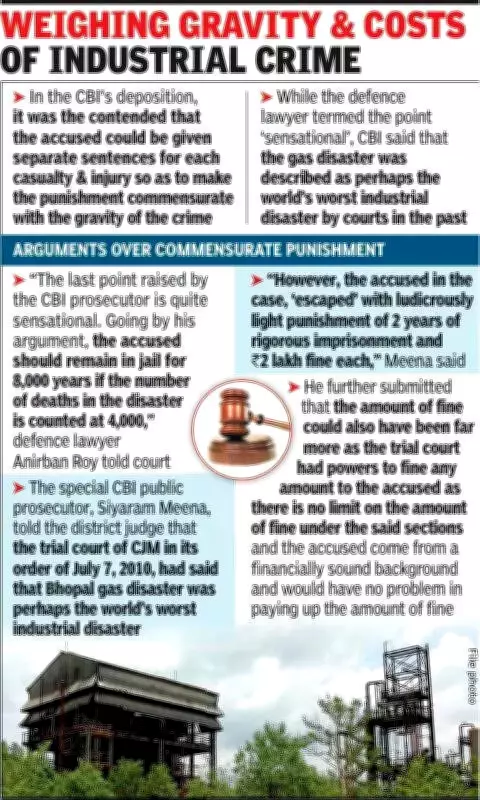
CBI counsel Meena argued that the accused had escaped with what he termed ludicrously light punishment. While the maximum punishment under Sections 304(a) and 338 of the Indian Penal Code is two years imprisonment, Meena contended that the trial court could have imposed consecutive sentences under both sections rather than concurrent ones.
Furthermore, he highlighted that the fines could have been substantially higher since the relevant sections impose no upper limit on financial penalties. Given the accused's financially secure backgrounds, more substantial fines would have been appropriate and within the court's authority.
A Sensational Legal Proposition
Perhaps the most striking argument presented was the CBI counsel's suggestion that separate sentences could be awarded for each casualty and injury, making the punishment proportional to the crime's magnitude. Defense lawyer Anirban Roy, present during the hearing, noted the sensational nature of this proposition.
Going by his argument, the accused should remain in jail for 8,000 years if the number of deaths in the disaster is counted at 4,000, Roy told the court, highlighting the extraordinary implications of the prosecution's position.
This ongoing legal battle continues to draw attention to one of India's most devastating industrial disasters, with survivors and victims' families awaiting justice nearly four decades after the tragedy unfolded.