

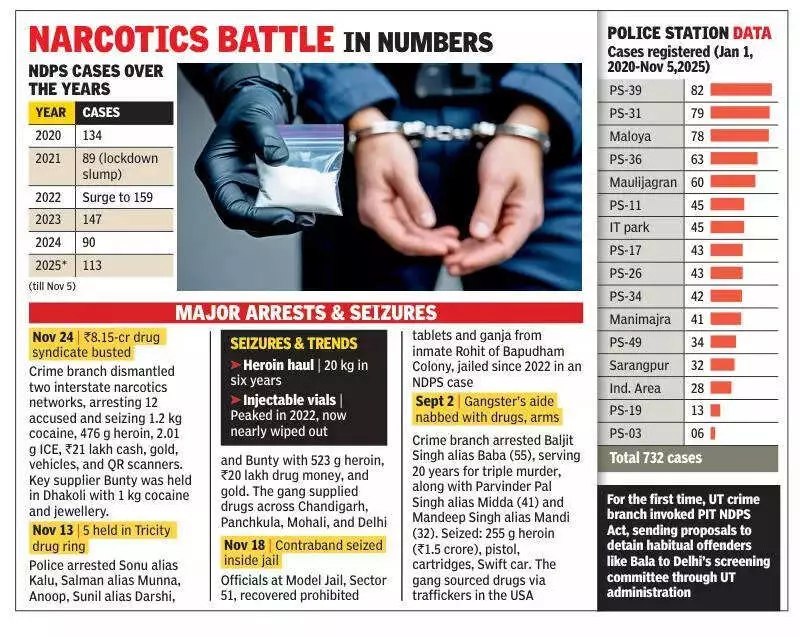
In a decisive and sustained campaign against the narcotics trade, the Chandigarh Police have delivered a crippling blow to the city's drug networks. Since the beginning of 2020, authorities have registered a staggering 732 cases under the Narcotic Drugs and Psychotropic Substances (NDPS) Act and apprehended 835 individuals involved in smuggling and peddling.
A Multi-Pronged Assault on the Drug Trade
The police offensive targeted the entire spectrum of illegal narcotics, from high-value substances like heroin and charas to opium, poppy husk, and banned injectable vials. The strategy extended beyond mere arrests, aiming to dismantle the financial backbone of these operations. In a significant move this year, properties and assets valued at approximately Rs 15 crore were frozen, severely disrupting the cash flow of the cartels.
Police officials point to the twin engines of easy money and rampant addiction that fuel this dangerous trade. The profit margins are substantial; peddlers typically purchase heroin for around Rs 2,000 per gram and sell it on the streets for as much as Rs 3,500, making it a highly lucrative, albeit deadly, business.

Tracking the Trends: Case Data and Key Hotspots
An analysis of police data reveals the evolving intensity of the crackdown. While 134 cases were registered in 2020, the number dipped to 89 in 2021, largely due to the nationwide lockdown restrictions. However, the figures surged again to 159 cases in 2022, followed by 147 in 2023. Last year saw 90 cases, and the current year's tally already stands at 113 cases.
The geographical distribution of cases highlights specific areas of concern. The Sector 39 police station recorded the highest number of cases at 82, closely followed by Sector 36 (79 cases) and Maloya (78 cases). In contrast, areas like Sector 3 registered only six cases, and Sector 19 recorded 13 cases over the same nearly six-year period.
Seizures, Shifts in Smuggling, and a Powerful New Legal Tool
Heroin has been at the center of most police actions, with a substantial 20 kilograms of the drug recovered during this period. After heroin, the most commonly seized substances were poppy husk, charas, and opium. Interestingly, while the smuggling of banned injectable vials saw a peak in 2022, it has nearly vanished now, with recent arrests predominantly involving heroin and charas.
In a landmark step to combat recidivism, the Chandigarh crime branch, for the first time, invoked the stringent Prevention of Illicit Traffic in NDPS Act (PIT NDPS) this year. This powerful law allows for the preventive detention of habitual offenders. Proposals to detain notorious peddlers, including a figure known as Bala, have been forwarded through the UT administration to the screening committee in Delhi.
Officials cite a combination of unemployment, addiction, and the lure of quick profits as the primary drivers pushing individuals into drug smuggling. The comprehensive crackdown by Chandigarh Police, combining seizures, arrests, asset freezing, and now preventive detention, represents a determined effort to cleanse the city of this scourge and protect its youth.






