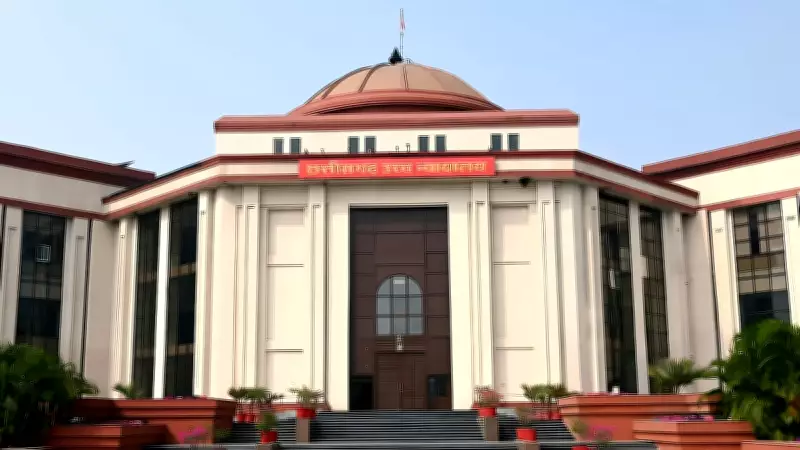
The Chhattisgarh High Court on Tuesday dismissed a petition challenging the state government's directive mandating the singing of Saraswati Vandana in all government schools. The court ruled that the order is not coercive and does not violate fundamental rights guaranteed under the Constitution.
Petitioners' Claims Rejected
The petitioners, including parents and activists, had argued that the directive violated Articles 14 (right to equality), 21 (right to life and personal liberty), 25 (freedom of conscience and free profession, practice and propagation of religion), 28(1) (freedom as to attendance at religious instruction or religious worship in certain educational institutions), 29 (protection of interests of minorities), and 30 (right of minorities to establish and administer educational institutions) of the Constitution. They contended that students from minority communities could feel compelled to participate in a religious practice not belonging to their faith.
The High Court bench, however, found no merit in these arguments. It observed that the singing of Saraswati Vandana is a cultural practice aimed at promoting the value of education, not a mandatory religious ritual. The court emphasized that the order does not compel any student to participate against their will, as it is merely a part of the school assembly routine.

Court's Rationale
Justice Sanjay K. Agrawal, heading the division bench, noted that the state's directive is similar to other school activities like the national anthem or pledge, which are secular in nature. "The Saraswati Vandana is a prayer for knowledge and wisdom, and its recitation in schools does not amount to imposing a particular religion on students," the court stated.
The court further clarified that the order is not coercive because no punishment or penalty is prescribed for non-participation. Students who do not wish to sing the Vandana can remain silent during the assembly. "The directive is merely a guideline to foster a culture of learning and respect for knowledge," the judgment added.
Government's Stand
The state government defended the directive, arguing that it promotes Indian culture and values without infringing on any fundamental rights. Advocate General Prafull N. Bharat submitted that the Vandana is a secular prayer for knowledge, akin to the Gayatri Mantra, and is not exclusive to any one religion. He cited several Supreme Court judgments that upheld similar practices in educational institutions.
The government also pointed out that similar prayers are already being conducted in many states across the country without any legal challenge. The court accepted these submissions and dismissed the petition, stating that the directive is within the realm of the state's power to prescribe curriculum and school activities.
Impact and Reactions
The ruling is expected to set a precedent for similar cases in other states. While the petitioners expressed disappointment, many parents and teachers welcomed the decision. "This is a victory for our cultural heritage. The Vandana instills a sense of discipline and reverence for knowledge among students," said a teacher from a government school in Raipur.
However, minority rights activists have voiced concern, arguing that the decision could embolden other states to introduce similar religious practices in schools. "The court has overlooked the sensitivities of minority communities. This could lead to further erosion of secularism in education," said a petitioner's lawyer.
The High Court's order is final, as no appeal has been filed yet. The case highlights the ongoing debate between cultural practices and constitutional rights in India's educational landscape.