

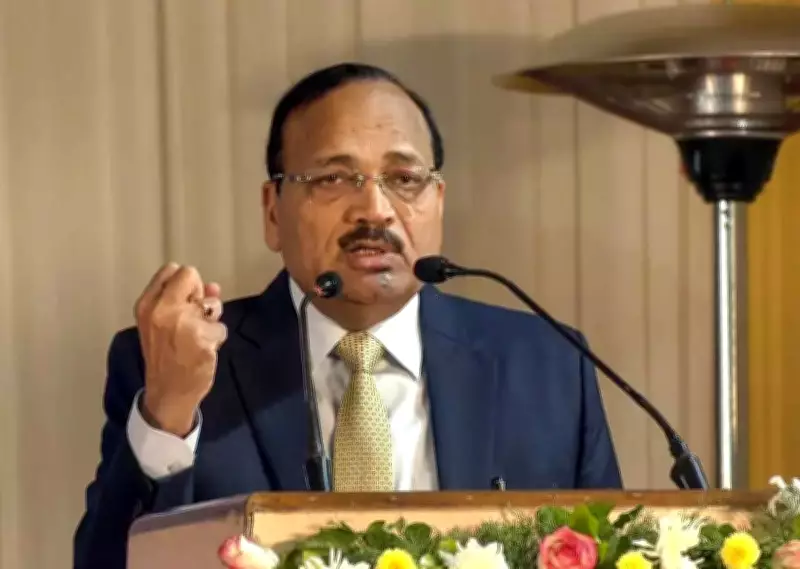
CJI Surya Kant Questions Court's Role as Arbiter of Faith in Sabarimala Hearing
Chief Justice of India Surya Kant on Wednesday articulated the profound difficulty faced by constitutional courts when asked to adjudicate on deeply held religious beliefs. "The most difficult part for a constitutional court is to give a ruling whether a centuries-old belief of millions of devotees is right or wrong," Justice Kant observed during proceedings before the nine-judge constitution bench he leads.
The bench is currently examining whether the judiciary can appropriately serve as arbiter in matters of faith and religion, a question that has gained renewed urgency in the context of the Sabarimala temple entry controversy.
Judicial Empathy for Devotee Perspectives
Justice M M Sundresh echoed the CJI's concerns, emphasizing the procedural challenge of making determinations about religious practices "without hearing the views of those millions of devotees and purely based on the plea of the PIL petitioners, state and religious organisations."

The remarks came as the Travancore Devaswom Board (TDB), the temple administration arm of the CPM-controlled Kerala government, presented its arguments before the bench. The Board contended that the Supreme Court could not have validly struck down the centuries-old custom barring entry of menstruating-age women into the Sabarimala Ayyappa temple.
Theological Foundation of the Restriction
Senior advocate A M Singhvi, representing the TDB, presented a detailed theological justification for the restriction. He explained that while women of all ages could worship Lord Ayyappa in more than 1,000 temples across India, the Sabarimala deity possessed unique attributes as an eternal celibate (Naistika Brahmachari).
"Lord Ayyappa in Sabarimala is the only form of Ayyappa as the eternal Bhramacharya, that is 'Naishtika Brahamachari'," Singhvi asserted, referencing the 2018 Supreme Court verdict on the temple entry issue.
He elaborated on the theological reasoning behind the restriction: "The very foundation of his prowess and fame is in his capacity as an eternal Brahmachari. All forms of female fertility and all practices of 'Grhasthasrama' have therefore to be scrupulously distanced from the intrinsic nature and identity of the deity."
Political Reversal and Constitutional Caution
Singhvi's arguments completed what observers have described as the Communist Party of India (Marxist)'s political pirouette on the issue. The party, which initially supported the 2018 Supreme Court verdict allowing women's entry, has now reversed its position with equal vigor following a significant political backlash that contributed to its poor performance in the 2024 Lok Sabha elections.
The TDB recommended that the Supreme Court exercise extreme caution when entertaining Public Interest Litigations (PILs) by individuals seeking judicial intervention in matters of faith, belief, and religion. Singhvi specifically argued that PILs, which enjoy relaxed locus standi requirements, should be discouraged in matters relating to religious rights.
Not Gender-Exclusionary, According to TDB
The Board emphasized that the restriction should not be construed as gender-exclusionary, noting that females below the age of 10 and above 50 are permitted entry to the Sabarimala temple. According to centuries-old religious belief, "the maintenance of the purity of the idol/deity in the form of a Naishtika Brahmacharya is also a paramount object which is sought to be achieved."
Faulting the 2018 Supreme Court judgment that termed the norm exclusionary, Singhvi argued: "This distancing and exclusion of fertile women with childbearing capacity thus has a direct nexus to the faith, belief and object for which the worshippers visit the deity and cannot remotely be construed to constitute exclusion on extraneous and irrelevant reasons."
The constitutional bench continues to grapple with the complex intersection of religious freedom, gender equality, and judicial authority as it considers whether courts should intervene in matters of deeply held religious belief.






