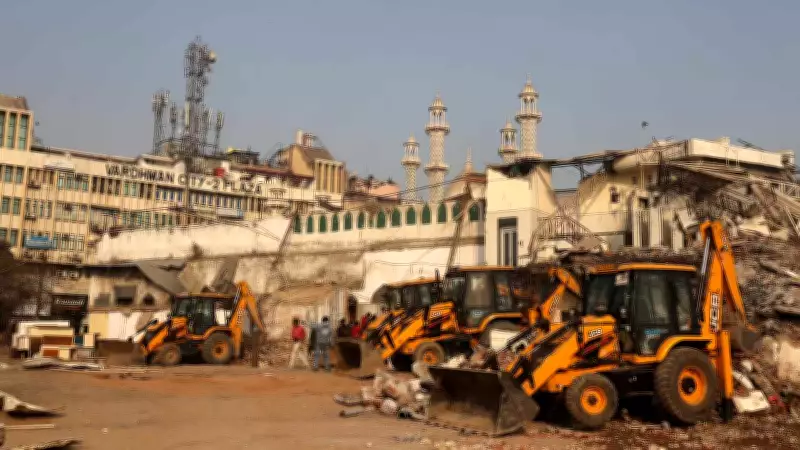
Delhi Court Raises Concerns Over Police Use of Zoomed-In Video Evidence in Turkman Gate Violence Case
A Delhi court, while hearing bail pleas for three individuals accused in last month's violence during a demolition drive near the Faiz-e-Ilahi mosque in the Turkman Gate area, has issued a cautionary directive to the police. On Thursday, Additional Sessions Judge Bhupinder Singh of Tis Hazari Court urged law enforcement to be "mindful" when basing accusations on video footage that has been zoomed in to identify faces, questioning the reliability of such evidence.
Court Questions Identification Methods in Bail Hearing
During the proceedings, the Investigating Officer (IO) informed the court that a head constable had captured video from the scene of the violence, which occurred on January 7 during Municipal Corporation of Delhi (MCD) actions to remove illegal structures. When asked how the accused were identified, the IO stated that faces were recognized by zooming into the footage, not through Facial Recognition System (FRS) technology, adding, "Yeh hamara roz ka kaam hai sir" (This is our daily work, sir).
Judge Singh responded with a firm warning, advising the IO to "be mindful" and stick to written statements to avoid inconsistencies. This exchange underscores growing judicial scrutiny over investigative techniques in high-profile cases.
Defense Arguments and Police Evidence in the Case
All nine accused in the Turkman Gate violence, including the three whose bail applications were under review, have contested the clarity of the video evidence. Their defense teams argue that:
- Faces are not clearly visible in the zoomed-in footage.
- There is no prima facie evidence linking them to stone-pelting or active participation in the clash.
- They were merely nearby to check on family or observe the commotion, not to join the mob.
In response, police have filed detailed replies for seven of the nine pending bail pleas, asserting that the accused are "clearly visible" in videos and that call data records (CDRs) for six individuals confirm their presence at the scene. Additional evidence includes:
- Chats recovered from seized mobile phones.
- Statements from eyewitness police officers.
- Alleged social media posts, such as videos shared on WhatsApp and Snapchat, and instigating audio messages.
Background of the Turkman Gate Incident and Legal Proceedings
The violence erupted early on January 7 when MCD bulldozers demolished encroachments around the Masjid & Dargah Syed Faiz-e-Ilahi, following a Delhi High Court rejection of an interim stay plea. The action led to clashes, with locals allegedly throwing stones and police responding with mild tear gas. Out of 20 arrests made, only one person has been granted bail so far, highlighting the case's complexity and ongoing legal battles.
The hearing is set to continue on Friday, with further arguments expected on the admissibility and interpretation of video evidence. This case brings to light broader issues of evidence integrity and police procedures in India's judicial system, particularly in contexts involving public unrest and digital media.