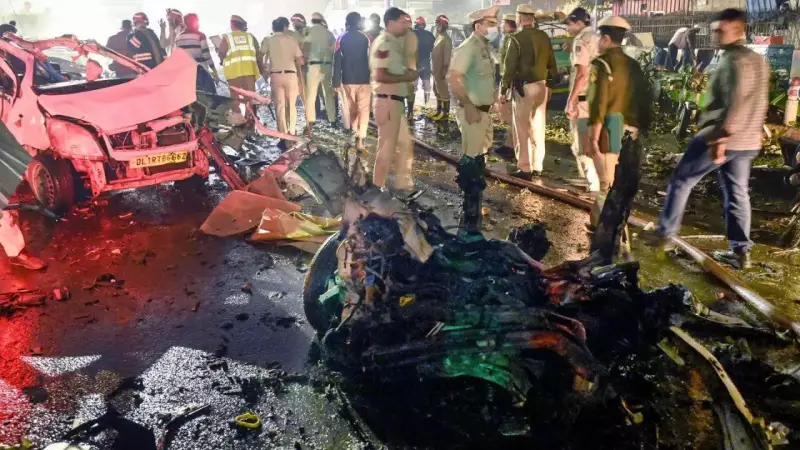
The piercing reminder of a car loan EMI on his mobile phone is now a source of dread for Sakir Khan. On December 5, an installment of Rs 21,730 is due for the Maruti Ertiga he bought in January, registering it as a cab to bring financial stability to his family in Sohna's Jaffarpur village. Today, that dream lies in ashes. The vehicle is a charred shell in a junkyard at Maurice Nagar Police Station, a grim relic of the November 10 blast near Delhi's Red Fort that killed 15 and injured 28.
A Fight for Survival Beyond the Hospital
Discharged from the hospital after fighting for his life, Sakir's battle has merely changed form. The compensation announced by the Delhi government remains elusive. Even accessing the scrap of his burnt vehicle—a crucial step to initiate an insurance claim—has become an ordeal. After weeks of futile visits to police stations and sub-divisional magistrate offices, Sakir and several other survivors have been forced to hire lawyers. Their sole demand is what was promised: damages and a means to restart their livelihoods.
"The blast changed my life forever. For three weeks, I have not been able to earn anything. I have EMIs to pay, my children's school fees are pending and I need money for my parents' treatment," said Sakir, who borrowed Rs 6,000 to engage legal help. He added that other cab drivers are also approaching lawyers just to get the basic insurance process moving.

Mounting Debts and Bureaucratic Hurdles
Shanawaz Khan, another survivor with severe injuries limiting his mobility, faces a similar nightmare. His cab was also destroyed. With no government relief or insurance clearance, his family is drowning in expenses. "I don't know how to feed my family. My cab is gone. We are running from pillar to post but no one is helping us out," he said, calling compensation a distant dream.
For these drivers, the blast has inflicted deeper financial wounds than physical ones. EMIs are mounting, savings are exhausted, and there is no clarity from authorities. Their frustrating experiences are identical: long queues, repeated queries, and confusion over whether their submitted documents are being processed.
Joginder Kumar, a 39-year-old cab driver from Nand Nagari, bought a new Swift Dzire in July to support his family of five. His EMI of Rs 19,000 is due on December 10. Tragically, the day after his last installment was deducted, the car was wrecked in the blast. He was 10 meters away, sustaining burns and injuries to his head, face, shoulders, and arms.
"I went from one thana to another to find my cab. I couldn't. I don't know how to initiate the insurance claim," Joginder said. He explained that insurance firms demand a copy of the FIR and a video of the car, but he cannot obtain either from the police station. Officers claiming to be from the National Investigation Agency (NIA) took his Aadhaar and bank details on November 16, but nothing has progressed since.
Legal Intervention and Official Standoff
Rakesh Kumar, a lawyer at Tis Hazari representing multiple blast survivors, stated he will move an application before the Patiala House Court seeking permission to access the vehicles. "Our first objective is to get the scrap released so that we can initiate insurance claims. Without that, these families can't take the first step to recover financially," he said.
However, Delhi government officials claim the delay is not on their part. An anonymous official stated that all required paperwork for compensation disbursal is complete. "We have processed everything at our end... But until the NIA confirms that the survivors are not linked to the blast accused, compensation cannot be released," the official said.
This explanation offers little comfort. Survivors like Sameer Khan, 21, who lost his family's autorickshaw and sustained severe burns, are relying on rented vehicles to survive. "All our details were taken at the hospital when the compensation was announced. But the officials aren't telling us anything," he said.

Delhi Police, for its part, said it has addressed the issue of accessing the vehicles for evidence. An officer noted that after the matter came to their notice, permission was granted to take photos and videos, and some have already done so. Yet, for survivors like Joginder and Sakir, the road to recovery remains blocked by red tape, unfulfilled promises, and the relentless ping of EMI reminders.