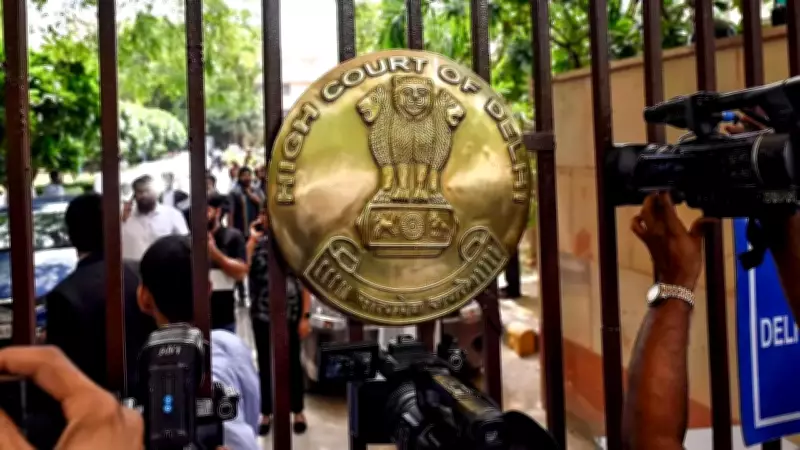
Delhi High Court Grants Bail in MCOCA Case, Citing Constitutional Rights Violation
In a landmark ruling, the Delhi High Court has granted bail to an individual charged under the stringent Maharashtra Control of Organised Crime Act (MCOCA). The court's decision was based on a finding that the accused's fundamental constitutional rights were violated due to the timing of his production before a magistrate, marking a significant emphasis on procedural safeguards in criminal law.
Case Background and Legal Proceedings
The appellant, identified as Harsh Pal Singh alias Rubal, was allegedly involved in an organized crime syndicate. He faced charges under the Bharatiya Nyaya Sanhita, 2023, and the Arms Act, in addition to the MCOCA provisions. The judgment was delivered by Justice Chandrasekharan Sudha on February 10, 2026, overturning a previous trial court order that had denied him bail.
Core Legal Dispute Over Arrest Timeline
The central issue in this case revolved around the timeline of Singh's arrest and subsequent court production. According to court records, Singh was detained at Amritsar Airport on the night of September 25, 2025, while attempting to travel to Bangkok. He was then handed over to the Delhi Police Special Cell and produced before a Special Court on September 27, 2025.

The defense team, led by Advocates Rajani and Nishant Rana, argued that the total time Singh spent in custody before being presented to a magistrate exceeded the 24-hour limit mandated by Article 22(2) of the Constitution and the Bharatiya Nagarik Suraksha Sanhita. This constitutional provision requires that any arrested person be produced before a magistrate within 24 hours of arrest.
Court's Findings on Custody Violations
The prosecution had claimed that Singh was briefly interrogated and released on a notice to join the investigation the next day. However, the Delhi High Court found these claims "quite doubtful" based on evidence presented. General Diary entries indicated that Singh's belongings, including his passport and bag, were handed over to the Delhi Police team, who then left with him in a government vehicle, making a formal release unlikely.
The court emphasized that the right to be produced before a magistrate within 24 hours is a peremptory constitutional mandate that must be strictly followed. Citing Supreme Court precedents, the court noted that any detention beyond this period without judicial authority renders the custody illegal, regardless of the gravity of the alleged offenses.
Prosecution Concerns and Bail Conditions
Despite the prosecution's concerns regarding the seriousness of the offenses and Singh's perceived attempt to abscond by booking a flight shortly after receiving a police notice, the court maintained that procedural law must be strictly adhered to. The court ruled that constitutional protections cannot be compromised even in cases involving serious charges.
Consequently, bail was granted under stringent conditions, including a personal bond of Rs two lakhs. The court's decision underscores the judiciary's commitment to upholding constitutional rights and ensuring that law enforcement agencies follow proper procedures in all cases, including those involving organized crime allegations.
Legal Implications and Significance
This ruling has significant implications for criminal procedure in India, particularly in cases involving special laws like MCOCA. It reinforces the principle that constitutional rights are paramount and must be protected even when dealing with serious criminal allegations. The decision serves as a reminder to law enforcement agencies about the importance of timely production of arrested persons before magistrates.
The case highlights the delicate balance between effective law enforcement and protection of individual rights, with the judiciary emphasizing that procedural safeguards are essential components of a fair justice system. This ruling may influence future cases where similar violations of constitutional rights are alleged in the context of organized crime investigations.