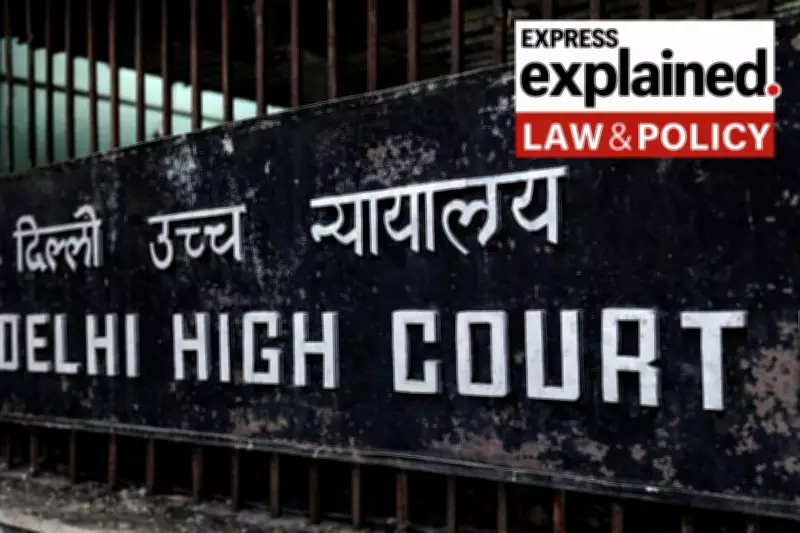
Delhi High Court Seeks Government Clarification on Frozen Embryo Donation Rules
The Delhi High Court has recently issued a notice to the Union government in response to a Public Interest Litigation (PIL) that challenges the existing regulations governing the donation of frozen embryos. This legal action raises critical questions about the ethical and legal frameworks surrounding assisted reproductive technologies in India.
Understanding the Petition and Its Core Arguments
The petition, filed by IVF specialist Dr. Aniruddha Narayan Malpani, contests what it describes as a "blanket prohibition" on the altruistic, voluntary, and consent-based donation of unused frozen embryos to infertile couples. It specifically targets provisions of the Assisted Reproductive Technology (Regulation) Act, 2021, and its accompanying Rules. Under current law, embryos can be created using donor sperm and donor eggs, but the donation of surplus frozen embryos for reproductive use by another couple is strictly prohibited.
Instead, such embryos may be stored for a maximum of ten years, after which they must either be "allowed to perish" or donated for research purposes. The plea argues that this mandate leads to the "irrational destruction of viable embryos", especially when there are willing recipient couples available. This, according to the petitioner, creates an ethical inconsistency in the legal framework.

Legal Observations and Government Response
During the hearing, a Division Bench comprising Chief Justice D K Upadhyaya and Justice Tejas Karia noted that the petitioner is seeking an expansion of the scope of Section 28 of the ART Act, which deals with the storage and handling of embryos. The court has directed the Union government to respond to these concerns, highlighting the need for a thorough review of the existing regulations.
What the ART Act Permits and Prohibits
The ART Act, enacted in 2021, allows for the altruistic donation of sperm and eggs under regulated conditions. It also permits donor-assisted IVF, including scenarios where an embryo is created from donor sperm and donor oocytes, resulting in a child with no genetic link to either parent. This form of non-genetic parenthood is accepted under the statute.
However, the law does not permit the donation of surplus frozen embryos. These embryos often result from IVF cycles that create multiple embryos to enhance success rates, but not all are implanted. Many couples later decide against further pregnancies, leaving their embryos cryopreserved. At this stage, the law restricts their use, prohibiting transfer to other parties except for personal use by the original couple with regulatory permission.
The Distinction Between Fresh and Frozen Embryos
A key issue raised in the plea is the legal distinction between fresh donor embryos and frozen embryos. Fresh embryos created using donor materials may be transferred to a commissioning couple, while frozen embryos, despite being biologically equivalent once thawed, are treated as non-transferable for reproductive purposes. The petition labels this as a "double standard", arguing that genetic non-linearity is accepted in fresh cases but rejected for frozen ones.
Constitutional Challenges and Ethical Implications
The petition bases its challenge on Articles 14 and 21 of the Indian Constitution. On equality grounds, it contends that the law creates an "arbitrary and constitutionally untenable distinction" between couples receiving fresh donor embryos and those seeking frozen embryos, as both involve children with no genetic link to the parents. It argues that this classification lacks a rational basis and fails the test of equality.
Regarding personal liberty, the petition asserts that reproductive choice falls within the right to life, dignity, and privacy. By denying embryo donation as a medically recognized option, the state is seen as intruding into decisional autonomy. The recurring theme of mandated destruction after ten years is criticized as a "legislative absurdity", especially when consenting recipients are available.

Why This Case Matters for India
Infertility affects an estimated 27-30 million couples in India, making access to affordable and effective reproductive options crucial. IVF is often expensive and requires multiple cycles, while traditional adoption involves lengthy waiting periods. The plea suggests that regulated embryo donation could provide an alternative pathway for some couples, enabling pregnancy and childbirth where other methods are unavailable.
Furthermore, the petition highlights access disparities, noting that wealthier couples might seek embryo donation abroad, while others cannot, effectively making reproductive choice dependent on financial means. This case underscores the need for a balanced approach that considers both ethical concerns and the practical realities faced by infertile couples in India.