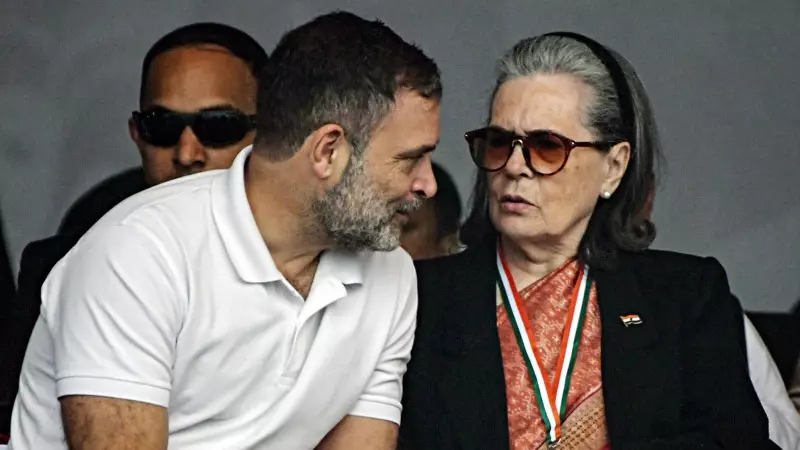
The Delhi High Court on Monday stepped into the legal fray surrounding the National Herald case, seeking formal responses from Congress leaders Rahul Gandhi and Sonia Gandhi, among others. This move came on a plea filed by the Enforcement Directorate (ED) challenging a trial court's recent order that had refused to take cognisance of the agency's chargesheet alleging money laundering.
Court Issues Notice, Next Hearing in March 2026
Justice Ravinder Dudeja of the Delhi High Court issued notices to all respondents, including Leader of Opposition Rahul Gandhi, former Congress president Sonia Gandhi, and other accused parties such as Suman Dubey and Sam Pitroda. The court has scheduled the next hearing for March 2026. The ED's revision petition targets the trial court's December 16, 2025 verdict, which had dealt a significant blow to the agency's prosecution.
ED's Stern Warning: Order Could 'Affect Several Cases'
Appearing for the ED, Solicitor General Tushar Mehta presented a forceful argument before the bench. He contended that if the trial court's order is allowed to stand, it would have far-reaching consequences and "affect several cases" under the Prevention of Money Laundering Act (PMLA). Mehta asserted that the trial court had "gone horribly wrong" in its interpretation.

The core of the legal dispute lies in the origin of the predicate offence. The trial court had declined to take cognisance because the scheduled offence—initially raised by BJP leader Subramanian Swamy in a private complaint in 2014—did not originate from an FIR filed by a police officer or an authorised investigating agency. The Supreme Court had later dismissed a challenge against the cognisance taken on Swamy's complaint.
Mehta argued that this distinction was flawed. "What is necessary is that there has to be an allegation, criminal activity pertaining to scheduled offence…whether the scheduled offence started with an FIR or a (private) criminal complaint... a criminal complaint stands on a much higher footing than an FIR," the SG submitted. He further pointed out that for many non-cognisable offences listed under the PMLA schedule, an FIR cannot be registered at all, making private complaints a valid starting point.
The Allegations at the Heart of the National Herald Case
The ED's chargesheet, filed on April 9, 2025, outlines a complex financial narrative. The agency alleges a criminal conspiracy by the Gandhis and other Congress functionaries to gain control over assets worth approximately Rs 2,000 crore belonging to Associated Journals Limited (AJL), the publisher of the National Herald newspaper.
The sequence, as per the ED, involves the All India Congress Committee (AICC) extending a loan of Rs 90.21 crore to the financially struggling AJL. Later, Young Indian—a not-for-profit company where Sonia and Rahul Gandhi collectively held a 76% shareholding—purchased the right to recover this debt from the AICC for just Rs 50 lakh. Subsequently, AJL allegedly converted the massive outstanding loan into equity shares issued to Young Indian.
The prosecution claims this manoeuvre effectively defrauded both the shareholders of AJL and the donors of the Congress party. The ED has argued that the trial court's order, by hinging on the nature of the complaint, gives a "hall pass" to a category of money launderers.
With the Delhi High Court now seized of the matter, the legal battle enters a crucial appellate phase. The court's eventual decision will not only determine the course of this high-profile case but also potentially set a precedent for how PMLA proceedings can be initiated based on private complaints.