

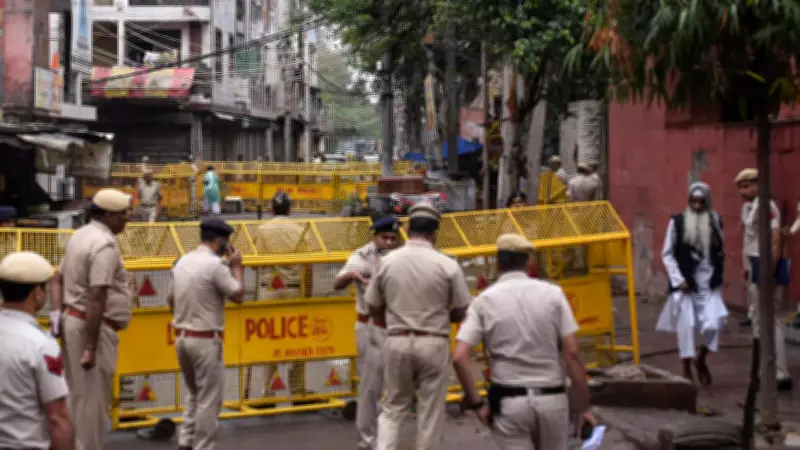
Hastsal Village Transformed into High-Security Zone After Tragic Holi Incident
The normally bustling lanes of Hastsal village in southwest Delhi's Uttam Nagar area are currently enveloped in an unsettling quiet, a stark departure from their usual festive vibrancy during the overlapping seasons of Navratri and Eid. This profound silence follows the tragic lynching of 26-year-old Tarun Butolia during Holi celebrations, an incident triggered when his cousin accidentally splashed water on a woman from another community. In response, the neighborhood has been converted into a fortified, high-security zone.
Unprecedented Security Measures Paralyze Daily Life
Delhi Police and Central Reserve Police Force (CRPF) personnel are now stationed at nearly every entry and exit point of the narrow lanes leading to Tarun Butolia's residence in A Block. This security ring extends comprehensively to B and C Blocks as well. Authorities have erected barricades even in lanes so narrow they can barely accommodate them, strictly regulating all movement in and out.
On a recent Friday, police were observed meticulously checking identity cards and verifying addresses of anyone attempting to enter the area. Only verified residents of Hastsal village were permitted access, with all others turned away. Vehicle movement has also been severely restricted, causing significant inconvenience to villagers going about their daily routines.

Surveillance has been intensified with the installation of approximately eight to ten CCTV cameras in the lane where Tarun lived, with additional cameras deployed on adjoining stretches and outer roads of the village. A senior police officer confirmed the deployment of four to five companies of paramilitary forces alongside roughly 450 Delhi Police personnel to prevent any further untoward incidents. A request for mounted police units has also been submitted, underscoring the seriousness of the situation.
Festive Celebrations Grind to a Halt Amid Tension
The contrast with previous years is deeply jarring for residents. Traditionally, Navratri would see tents pitched across lanes, women hosting day-long keertan sessions, and children gathering to play musical instruments like manjira and small dhols. With Eid festivities also commencing, the neighborhood would typically be a hub of joyful activity and communal gathering.
This year, however, the streets of Hastsal are largely deserted. The heavy security presence has effectively canceled public celebrations. One resident expressed the collective frustration, questioning, "How can we celebrate when they are checking everyone's IDs and not allowing even our relatives to enter the area?" The festive spirit has been supplanted by an atmosphere of caution and restriction.
Residents Defend Communal Harmony, Blame Outsiders for Escalation
Despite the massive security deployment—which includes two busloads of CRPF personnel stationed near the local eidgah, close to the crime scene—many locals insist that the underlying communal fabric of the neighborhood remains intact. While the family members of the accused have fled, leaving their house empty, local Muslim families are adamant about staying put.
Mohammad Hamid, a 30-year-old resident, emphasized the long history of coexistence, stating, "We have been living together here for decades, and communal tension has never been an issue. The murder is a tragedy, but fear is being unnecessarily stirred up. Outsiders are trying to politicise this issue and escalate tensions."
Shaheeda, who lives in a lane opposite Tarun's house, noted that the tight security has prompted some families, particularly migrants from Uttar Pradesh and Rajasthan who frequently travel for Eid, to leave temporarily. However, this is framed as a practical response to the lockdown-like conditions, not a sign of communal flight.

Community Leaders and Neighbors Work to Dispel Rumors
The sentiment of enduring communal bonhomie is echoed by Hindu residents as well. Sunita, residing in the lane behind Tarun's house, highlighted the inclusive nature of local traditions like kanjak during Navratri, where young girls are fed regardless of their religious background. "When we ask young girls to come and eat in our house, we don't ask whether they are Hindus or Muslims. Every girl is a kanya, and we treat them with respect," she explained.
Local businessmen are actively countering narratives of communal migration. Mahesh Chand, 53, who has run a ration shop in the locality for nearly half a century, dismissed reports of families fleeing. "In the last three days, several Muslims have bought wheat and rice from me as usual. No families are leaving. We need to stop fearmongering," he asserted, pointing to continued daily commerce as evidence of normalcy beneath the security blanket.
The situation in Hastsal village presents a complex picture: a community grappling with the aftermath of a violent crime under the shadow of overwhelming security, yet fiercely protective of its long-standing interfaith harmony. The heavy police presence, while aimed at preventing violence, has inadvertently silenced the cultural and religious expressions that typically define this time of year, leaving residents in a state of suspended animation between tragedy and tradition.





