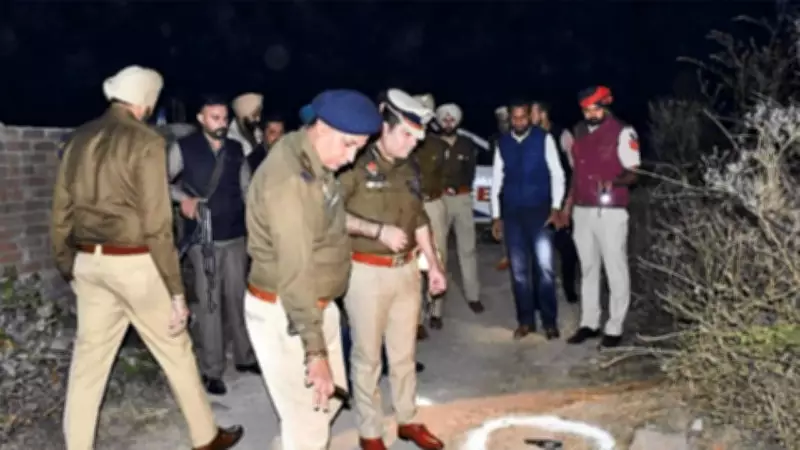
A senior Punjab Police officer expressed concern over the ease of recruiting killers for small sums, driven by drugs and joblessness. The officer noted that drug addicts are becoming assassins, with recent crimes highlighting how little is paid for such acts.
Low Payments for High Crimes
For instance, grenade attacks on police outposts in Patiala and Haryana's Ajimgarh in April 2025 were carried out for just Rs 5,500 each, though the promised amount was Rs 3-4 lakh. Similarly, a grenade blast outside the Punjab BJP HQ in Chandigarh saw two accused promised Rs 2 lakh each but receiving only Rs 19,000 in two instalments and Rs 18,665 in nine instalments.
A gunman who fired at migrant workers in Moga in February 2025 received only Rs 7,500 from a foreign handler. Security agencies highlight Punjab's high youth unemployment in rural and semi-urban areas, social media exposure to gangster culture, and existing extortion and arms supply routes as key factors.

ISI Involvement
Security agencies also point to a plot by Pakistan's Inter-Services Intelligence (ISI) to destabilize Punjab through a nexus of terror operatives and gangsters. In the murder of two policemen in Gurdaspur on February 22, 2025, accused Dilawar Singh received Rs 3,000 of the promised Rs 20,000 from ISI, which had offered Rs 2-4 lakh to the three men involved.
A senior officer noted that gangsters and ISI agents increasingly target young boys, minors, drug addicts, and the poor, who are desperate enough to kill for Rs 10,000. Foreign-based radicals also lure youngsters with promises of foreign visas.
Psychological Manipulation
Police observe a growing operational model where foreign-based handlers use psychological manipulation and false financial assurances instead of substantial payments. This lowers financial barriers to violence and increases radicalization risk among economically vulnerable groups.
In a foiled ISI plot on November 20, 2025, two Rajasthan-based suspects agreed to throw hand grenades for Rs 25,000. Another suspect, a drug addict, agreed to do the job for Rs 12,000 cash and 2 grams of heroin. Pakistan-based handlers Shehzad Bhatti, Abid Jatt, and Mussa Khan use multiple Instagram accounts to contact needy individuals.
Low Risk, High Impact
In an extortion racket run by gangster Goldy Brar, 10 local youths were recruited for tasks like identifying businessmen and shooting at residences. They were promised Rs 10,000 per task plus drugs, but only two received money after firing at a shop. Investigators say most perpetrators do not receive the full promised amount, often getting only Rs 5,000-8,000 initially and then being cut off.
One accused in a grenade blast at a Mohali police station received Rs 5,500 from a US-based handler, while the alleged mastermind promised Rs 3-4 lakh. This calculated approach exploits vulnerable individuals with false promises, treating operatives as expendable assets.
Three-Step Recruitment Process
Investigators describe a three-stage recruitment process. First, recruiters identify drug addicts, victims of enmity, or those with personal grudges, as well as individuals showing fascination with guns or gangster lifestyle on social media. Second, soft grooming involves casual friendship and small cash help, followed by low-risk tasks like delivering parcels or buying SIM cards. Finally, once the youth are hooked, they are assigned roles like reconnaissance, transporting firearms, or using vehicles in crimes.
Interrogations reveal that recruiters pay very little in advance, leaving recruits to face consequences and leading to irreversible criminalization.
Need for Jobs and Anti-Drug Campaign
Police officers emphasize that providing jobs and waging an all-out war on drugs is essential. One officer stated, "Give the youth jobs. Give them hope. Why would they risk a safe job for a risky crime that pays peanuts? Employment would solve much of the problem."
Since the launch of Punjab's anti-drug campaign 'Yudh Nashian Viruddh' earlier this year, over 63,700 suspects have been arrested and thousands of kilograms of drugs seized. Punjab Chief Minister Bhagwant Mann has vowed to "erase the blot of drugs."