

ED Probe Exposes Pipeline of Exploitation in Illegal Surrogacy and Baby-Selling Racket
The Enforcement Directorate (ED) has uncovered a deeply disturbing 'pipeline of exploitation' within an illegal surrogacy and baby-selling racket operating in Hyderabad. The investigation reveals a criminal hierarchy where women who initially sought quick money through clinical trials, egg donation, and surrogacy were systematically recruited into the network over time.
From Clinical Trial Participant to Recruiter
The provisional attachment order dated March 9, linked to Dr. Pachipala Namratha, shows that several lead agents first entered the system as trial participants, egg donors, or surrogate mothers. These individuals were later used to identify, persuade, and channel other women in financial distress into selling their newborns.
One of the accused, Muthipeta Nandhini from Hyderabad, exemplifies this transition. Nandhini first participated in clinical trials at laboratories in Bangalore, Hyderabad, and Chennai, earning 15,000 to 20,000 per trial. She later acted as a surrogate mother twice, receiving 7.5 lakh, and sold her eggs on two occasions.

Her role evolved from participant to agent when she began using her contacts among fellow trial participants to identify women in financial distress. Along with her husband, Muthipeta Sanjay, she identified Nasreen Begum, a fellow clinical trial participant who was eight months pregnant and in debt. Nandhini persuaded Begum to sell her baby to Dr. Namratha's clinic instead of seeking an abortion.
The ED also named Mohammed Ali Adik and Nasreen Begum as the biological parents in one case, noting they were drawn into the network through Sanjay, who was Ali Adik's former colleague and a fellow clinical trial participant.
Egg Donors Move Up the Chain
The attachment order reveals that the network also relied on egg donors who gradually became recruiters and handlers. Dhanasri Santoshi from Hyderabad began as an egg donor in 2012, donating approximately 12 times at various fertility centers. Over time, she developed what the ED describes as a 'strong network.'
Santoshi became a lead agent, charging a commission of 5,000 per donor while managing a layered network of sub-agents to procure pregnant women from Telangana and Andhra Pradesh.
Another accused, Shahina, a Rajasthani woman living near Aramghar in Hyderabad, worked as a sub-agent for Santoshi. Her role included identifying and sourcing pregnant women for commissions of about 50,000.
Harsha Roy is described in the ED order as a key sub-agent. She met Nandhini through donor circles and later played a role in directing Nandhini and Nasreen Begum to Dr. Namratha's clinic for the illegal sale of a newborn.
The investigation identified Pasupuleti Lavanya as an 'egg donor-cum-agent.' She worked as a donor and later sourced two pregnant women for the network.
Surrogates, Relatives, and Labor Networks
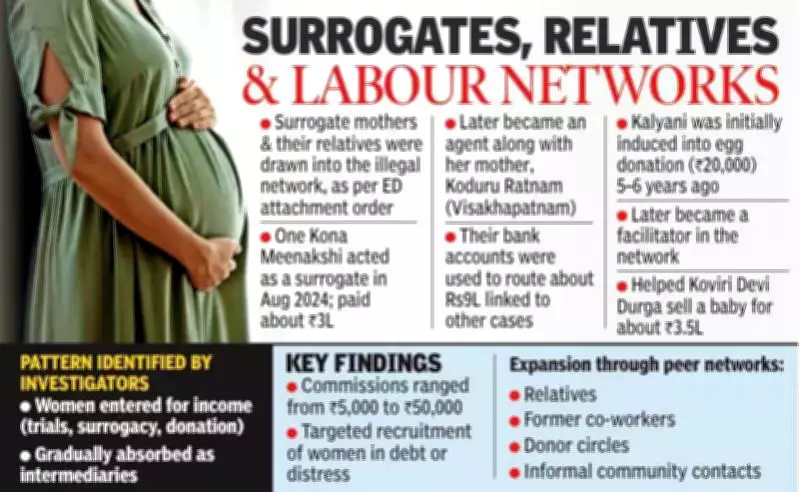
The ED attachment order states that surrogate mothers and their relatives were also drawn into the chain. Kona Meenakshi initially acted as a surrogate mother in August 2024 and was paid about 3 lakh. After that, she and her mother, Koduru Ratnam from Visakhapatnam, acted as agents by allowing their bank accounts to be used to route approximately 9 lakh in payments linked to other pregnant women.
In another instance, the investigation cited Kalyani, who was first induced to donate eggs five to six years ago for 20,000 and later became a facilitator. She assisted Koviri Devi Durga in selling a baby to the clinic for 3.5 lakh and handled the distribution of the money.
The investigation found a consistent pattern where women who entered the fertility and trial ecosystem in search of money were not kept at its margins but were absorbed into it as intermediaries. The probe revealed commissions ranging from 5,000 to 50,000, the recruitment of women in debt or distress, and peer-to-peer expansion through relatives, former co-workers, donor circles, and informal community contacts.
The ED's findings highlight a systematic exploitation of vulnerable women, transforming them from victims into perpetrators within a sophisticated criminal network.






