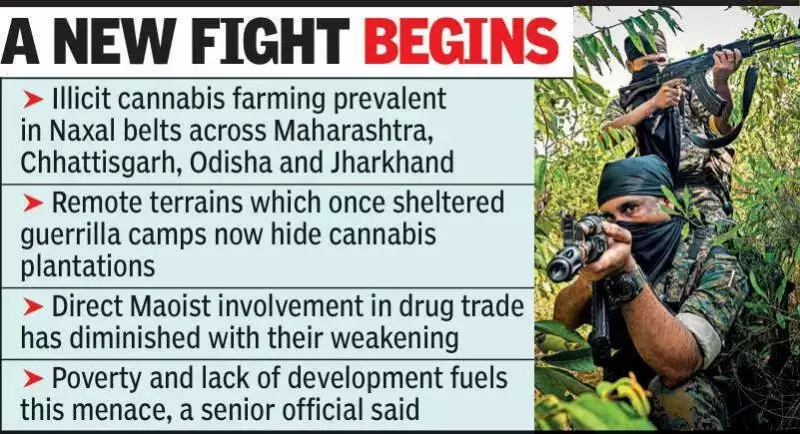
In a dramatic shift for a region long synonymous with left-wing extremism, security forces in Maharashtra's Gadchiroli district are confronting a new and growing threat: the widespread cultivation and trafficking of cannabis. As sustained commando operations have reduced the frequency of Maoist guerrilla ambushes, remote villages are increasingly becoming hubs for illicit drug production, according to local police.
Major Bust in Hitkasa Village
Acting on specific intelligence, a police team led by Inspector Arun Fegade raided the residence of 45-year-old Punaram Madavi in Hitkasa village under Korchi police limits on January 5. The operation yielded a significant haul right from the porch of his house.
Officers discovered 160 cannabis plants in various stages of growth. Some were fresh with green leaves, flowers, and buds, while others were semi-dried. The total seized contraband weighed approximately 30 kilograms, with an estimated street value of around 15 lakh rupees (calculated at 50,000 rupees per kg). An electronic weighing scale was also confiscated during the raid.

Madavi was arrested and charged under the stringent NDPS Act (Narcotic Drugs and Psychotropic Substances Act). A local court remanded him to two days of police custody, and further investigation is currently underway by the Korchi police.
Link to Larger Network and Police Access
This raid was not an isolated incident. Inspector Fegade's team also targeted a farm in Malewada in north Gadchiroli, seizing cannabis plants. This location had been raided just a fortnight earlier, where police confiscated cannabis worth more than 1 crore rupees.
Gadchiroli Superintendent of Police Neelotpal provided crucial context for these intensified operations. He revealed that the recent crackdown began after two students were caught with cannabis in Pune. Their interrogation led investigators back to the source in Malewada.
SP Neelotpal highlighted a key factor enabling these deep-forest raids: the diminished Maoist threat. "The raids are taking place now because police are freely operating deep inside the forested areas without guerrilla threats," he stated. This improved access has allowed law enforcement to penetrate areas where their presence was minimal for decades.
A Vacuum Filled by Narcotics
The busts underscore a worrying new trend in the district's interior regions, which were once hotbeds of Maoist activity. For over 50 years, Gadchiroli was defined by Left-Wing Extremism. While concerted security efforts have led to a sharp reduction in Maoist violence, the vacuum appears to be filled by organized narcotics cultivation.
Police officials note that while drug money funding of Maoist activities hasn't been conclusively established yet, the pattern of cannabis cultivation taking root in these remote, formerly inaccessible areas is clear and presents a fresh law and order challenge.
The transformation of Gadchiroli from a guerrilla warfare zone to a potential narcotics production center marks a critical new phase in the region's complex security landscape, demanding a recalibrated strategy from security forces.