

Ghatkopar Hoarding Tragedy Probe Uncovers Criminal Conspiracy Involving Officials
A high-level committee led by former Allahabad High Court Chief Justice Dilip Bhosale, appointed to investigate the Ghatkopar hoarding tragedy, has revealed a criminal conspiracy involving key individuals. The report, tabled in the Maharashtra state assembly on Tuesday, implicates suspended IPS officer Quaiser Khalid, BMC official Sunil Dalvi, Ego Media directors Bhavesh Bhinde and Janhavi Marathe, and businessman Mohammed Arshad Khan.
Details of the Criminal Conspiracy
The committee's findings state that the sequence of events strongly points to a criminal conspiracy hatched among these individuals. This conspiracy was aimed at perpetrating illegalities and circumventing BMC regulations, ultimately leading to the loss of 17 lives in the incident on May 13, 2024. The report emphasizes that not only was there suspicion of conspiracy, but actual illegal acts were committed that contributed to the tragedy.
Land Classification and Regulatory Bypass
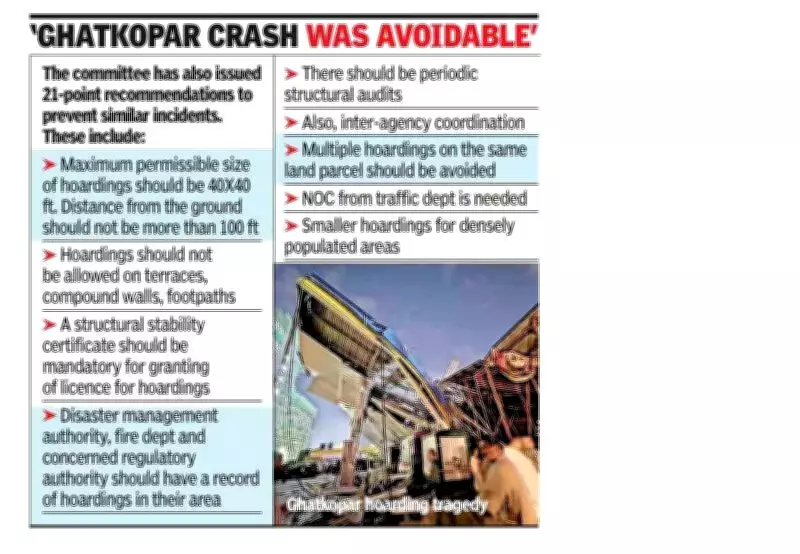
The report concludes that the land where the hoardings were erected was partly owned by the Maharashtra government for railway police use and partly by the Police Welfare Corporation. However, it was incorrectly classified as "railway property" under the Railways Act, 1989. This misclassification was exploited to bypass BMC regulations, which restrict hoardings to a maximum size of 40×40 feet.

Originally, a railway police e-tender had granted three hoardings, each 40×40 feet back-to-back, totaling 9,600 square feet, to Ego Media for a 10-year period. After Quaiser Khalid became commissioner of railway police, he unilaterally expanded these three hoardings to a total frontage of 38,400 square feet, extended their operational period from 10 to 30 years, and approved a fourth hoarding measuring 120×140 feet back-to-back, covering 33,600 square feet. The report notes that Khalid made these changes without issuing fresh tenders or seeking permission from the DGP office.
Irregularities in Tender Processes
The committee also highlighted that Khalid refused permission to a competitor, Qicom, to install an additional hoarding without even inviting their commercial proposal. Instead, he granted this right to Ego Media without any tender process or DGP approval. These actions were taken despite opposition from the BMC and BPCL, and were based on legal opinions that mischaracterized the land as railway property. The hoarding eventually collapsed onto the canopy of a BPCL petrol pump in Ghatkopar.
Avoidable Nature of the Collapse
The committee pointed out that the hoarding collapse was avoidable, relying on reports from VJTI and the Petroleum and Natural Gas Regulatory Board (PNGRB). The VJTI report indicated that if the specifications had been followed, the hoarding would have been able to withstand higher wind forces. The PNGRB report suggested that if the petrol pump had complied with rules, there would have been fewer people on its premises at the time of the incident.
Financial Irregularities Uncovered
The probe uncovered significant financial irregularities. Mohammed Arshad Khan, a long-time associate of Ego Media director Bhavesh Bhinde, reportedly handed over blank cheques worth Rs 84 lakh from Ego Media. These cheques were deposited into multiple accounts and converted into cash, which was allegedly handed over to Khalid.
Involvement of BMC Official
The report states that Sunil Dalvi, then BMC senior inspector (Licence) for N ward, maintained contact with Bhinde during the hoarding construction. Dalvi sanctioned an unsecured loan of Rs 45 lakh to Bhinde and Marathe, directors of Ego Media. This indicates that Dalvi had a connection with them and was incentivized to overlook the illegal hoarding erection.
The findings underscore a systemic failure and collusion among officials and private entities, leading to a preventable disaster that claimed multiple lives in Mumbai.






