

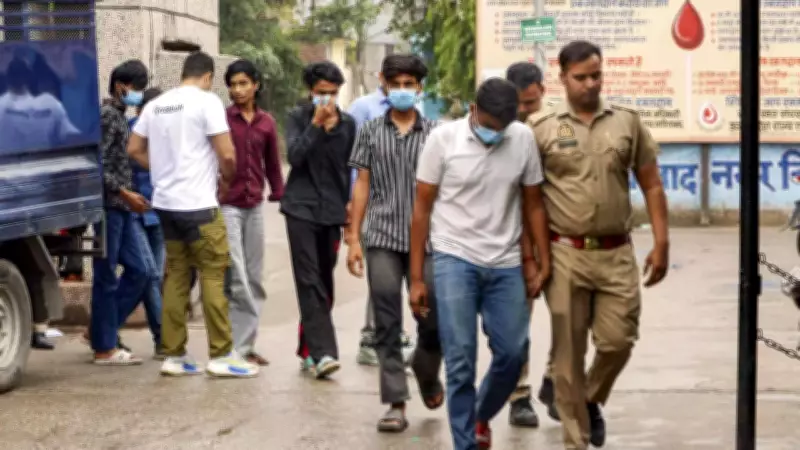
Ghaziabad Police Uncover Cross-Border Espionage Network Targeting Vulnerable Youth
In a significant breakthrough, Ghaziabad police have dismantled an alleged cross-border espionage network that systematically recruited young men from Uttar Pradesh, Bihar, and even Nepal through social media platforms. The operation reveals a disturbing pattern of exploitation, where individuals facing financial hardship were lured with promises of quick cash to gather intelligence on sensitive Indian locations.
Social Media Lures and Financial Exploitation
According to senior police officials, the network's mastermind, identified as Sardar Jora operating from Pakistan, specifically targeted individuals with weak financial backgrounds and limited education. "He would first strike up conversations on social media, carefully assess their family and monetary problems, and then offer easy work for immediate payment," explained a senior officer involved in the investigation.
The recruitment strategy was calculated and predatory. Jora allegedly used social media platforms to identify vulnerable youth, understand their economic struggles, and then present espionage activities as simple photographic assignments that promised substantial financial rewards.

From Dhaba Workers to Espionage Operatives
One of the key accused, Sohail Malik, revealed to investigators how he transitioned from working at a Pune dhaba to becoming an active participant in the espionage network. Along with fellow dhaba worker Raj Valmiki, both earning between Rs 8,000 to Rs 10,000 monthly, Malik was initially approached by Jora with offers of money for photographs of Indian locations.
"At first, Sohail received payments ranging from Rs 2,000 to Rs 5,000 for each photograph," the officer detailed. "Once he realized how easily the money came and in increasingly larger amounts, he abandoned his dhaba job in 2025 and subsequently recruited Raj into the expanding network."
Network Expansion and Operational Details
Police investigations indicate that Naushad Ali, Sohail Malik, and Sameer played central roles in expanding the espionage module, actively recruiting relatives, friends, and other financially distressed individuals. A dedicated WhatsApp group created by Jora reportedly contained more than twenty members coordinating their activities.
The network's operations involved:
- Photographing railway stations, cantonment areas, and other public places
- Pinning exact GPS coordinates of sensitive locations
- Sharing collected material with Pakistani handlers
- Receiving payments through hawala channels, local shops, and middlemen
Diverse Recruitment Pool and Sophisticated Operations
Among those allegedly recruited was Gagan Kumar Prajapati, a 22-year-old from Meerut with intermediate education, who shared details of his family's financial distress online before being assigned to photograph locations in Delhi. Ganesh Giri, a 20-year-old Nepal native residing in Meerut, and Vivek Rai, an 18-year-old from Bihar living in Bhowapura, both previously worked as laborers before joining the network.
Sane Iram, also known as Mehak, a 25-year-old from Sambhal, had reportedly been active in the network for over eighteen months and maintained direct communication with Jora and another operative, passing along instructions from higher-ups.
Durgesh Nishad, a 26-year-old Jaunpur resident working as a truck driver in Mumbai, was arrested for allegedly facilitating fund transfers. Police examining bank accounts of six accused arrested on March 14 discovered substantial evidence of foreign funding that eventually led investigators to Nishad.
Advanced Surveillance and Payment Structure
Additional Commissioner of Police Raj Karan Nayyar revealed that the accused not only filmed sensitive sites and shared photographs, videos, and GPS coordinates but in some instances installed solar-powered SIM-based CCTV cameras at strategic locations including Delhi Cantt and Sonipat railway stations.
"They received payments ranging approximately from Rs 5,000 to Rs 15,000 per assigned task," confirmed an investigating officer, highlighting the financial incentives that made the illegal activities appealing to economically vulnerable youth.

The investigation continues as authorities work to uncover the full extent of this cross-border espionage network and identify all individuals involved in compromising national security through social media recruitment of financially distressed youth.





