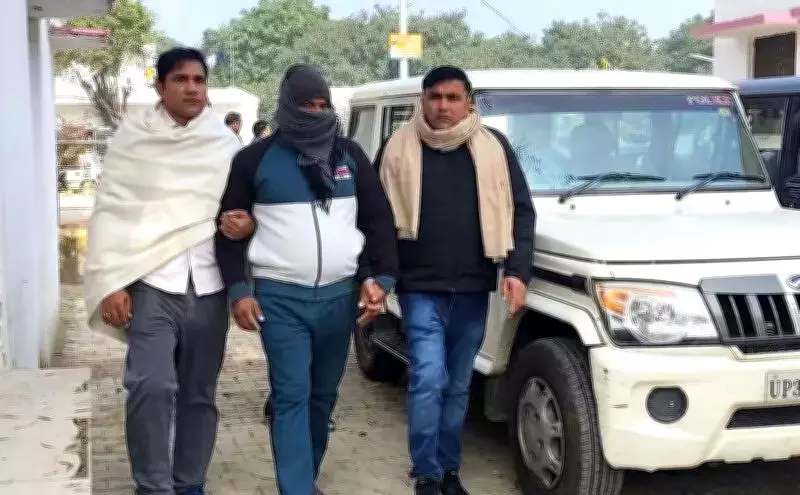
Ghaziabad Police Inspector Caught Red-Handed in Bribery Sting Operation
In a shocking incident that highlights corruption within law enforcement, the Station House Officer (SHO) of Niwari police station in Ghaziabad was arrested right in his own office by a vigilance team from Meerut. The arrest came after the officer, identified as Jaipal Singh Rawat, was allegedly caught accepting a bribe of Rs 50,000 to manipulate an ongoing investigation.
The Alleged Bribery Scheme and False FIR
The case revolves around Rakesh Kumar, a former pradhan of Abupur village, who found himself embroiled in what he claims was a false criminal case. According to police sources, an FIR was registered against Kumar at Niwari police station on January 2 based on a complaint filed by Vijay Singh. The complaint accused Kumar of making indecent remarks against both the Chief Minister and the Prime Minister.
Kumar vehemently denied the allegations, presenting what he considered irrefutable evidence of his innocence. He stated that he was not present at the location where the remarks were allegedly made. Instead, he was conducting business at a State Bank of India branch at the time, and he offered to provide location details and CCTV footage to substantiate his claim.
Electoral Rivalry and Police Threats
The former village pradhan told officials that the complaint against him was not based on factual events but rather the fallout of longstanding electoral rivalry within the village. According to Kumar's account, SHO Rawat exploited this situation by threatening him with arrest unless he paid Rs 50,000 to have his name removed from the FIR.
Kumar and his wife initially approached senior police officials seeking relief from what they perceived as harassment and extortion. When their complaints to higher authorities failed to yield results, they escalated the matter to the Meerut vigilance unit on Monday, February 5. Their complaint detailed additional allegations, including that on February 1, Rawat had visited their home, conducted what they described as an unauthorized raid, and reiterated threats of arrest.
The Elaborate Vigilance Trap
Vigilance officers meticulously planned a sting operation for Tuesday, February 6. Two members of the vigilance team entered Niwari police station disguised in plain clothes and wearing shawls. They maintained surveillance while pretending to file a complaint about a missing mobile phone, blending seamlessly with other visitors to the station.
When Kumar arrived at the SHO's office and handed over the marked Rs 50,000, the vigilance team sprang into action. Officials reported that Rawat immediately placed the cash bundles—which had been treated with a special chemical for the phenolphthalein test—into his pocket. As the vigilance officers approached to apprehend him, Rawat reportedly threw the money to the ground in a desperate attempt to distance himself from the evidence.
Scientific Evidence and Immediate Aftermath
Despite Rawat's attempt to discard the marked currency, the chemical treatment on the notes had already transferred to his hands. When investigators conducted the standard phenolphthalein test by placing his hands in water, the solution turned pink—conclusive scientific proof of his contact with the treated money. This evidence led to his immediate arrest on the spot.
A subsequent search was conducted at Rawat's residence, though officials reported that no additional cash was recovered during this operation. The 12-member vigilance team that executed the successful sting was led by an officer of deputy superintendent of police rank, demonstrating the seriousness with which the anti-corruption unit approached the case.
Official Statements and Career Background
Surendra Nath Tiwari, Deputy Commissioner of Police (Rural), confirmed the arrest and provided details about the ongoing investigation. "An FIR will be registered at Niwari police station soon," Tiwari stated. "The vigilance team has arrested Rawat, and further investigation is currently underway to examine all aspects of this case."
Rawat, a 2013-batch sub-inspector who had been promoted to inspector approximately one year ago, was serving his first assignment as Station House Officer at Niwari police station. His arrest in his own office represents a significant embarrassment for the police department and raises questions about accountability mechanisms within law enforcement agencies.
The case continues to develop as investigators examine the broader implications of the alleged corruption and whether similar practices might have occurred during Rawat's tenure. The vigilance department's successful operation demonstrates the ongoing efforts to combat corruption within Uttar Pradesh's police force, particularly in sensitive positions of authority.