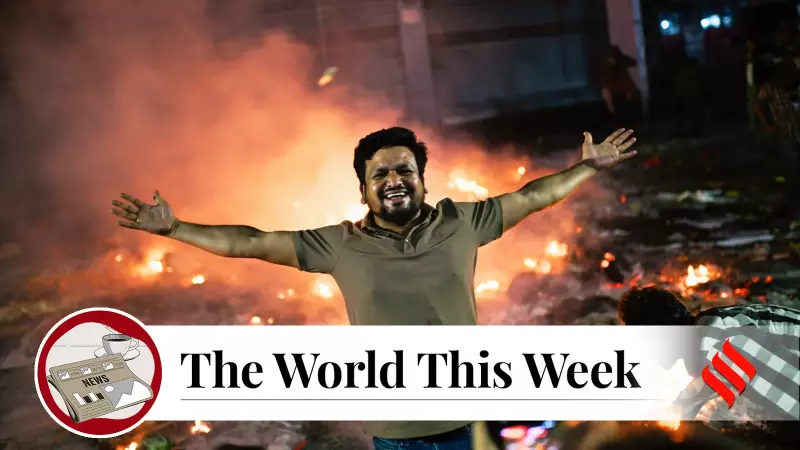
This week, the global stage witnessed significant developments with profound regional and international implications. From escalating civil unrest in Bangladesh to high-level diplomatic engagements by India's Prime Minister and a pivotal election in Venezuela, the geopolitical landscape remains dynamic and consequential.
Bangladesh Seethes Amid Student-Led Protests and Government Crackdown
The streets of Dhaka and other major cities in Bangladesh have become the epicentre of intense and often violent demonstrations. The spark for this latest wave of unrest was the government's decision to implement a quota system for public sector jobs, which reserves a significant percentage of positions for children of freedom fighters from the 1971 Liberation War. Student groups and opposition parties argue that the system is outdated, unfair, and curtails merit-based opportunities for the vast majority of the country's youth.
Protests, led primarily by university students, have escalated dramatically. The situation turned particularly grim on July 17-18, when clashes between protesters and law enforcement resulted in a tragic loss of life and numerous injuries. The government's response, involving a widespread internet shutdown and a harsh crackdown, has drawn sharp criticism from human rights organizations and foreign observers. The core demand from the protesting students is the complete abolition of the quota system, a move the government has so far resisted, leading to a dangerous political stalemate.

Prime Minister Modi's Strategic Three-Nation Diplomacy
Against this backdrop of regional tension, Indian Prime Minister Narendra Modi embarked on a strategically crucial three-nation tour from July 8 to July 10. His itinerary included visits to Russia, Austria, and a brief stop in Oman, each serving distinct diplomatic objectives for India.
The visit to Moscow, Russia was of paramount importance, marking Modi's first bilateral trip since beginning his third term. The summit with President Vladimir Putin focused on strengthening the longstanding special and privileged strategic partnership between the two nations. Key discussion points included:
- Enhancing bilateral trade and economic cooperation, particularly in energy.
- Addressing the logistical challenges faced by Indian nationals in the Russia-Ukraine conflict zone.
- Exchanging perspectives on global and regional issues, including the situations in Ukraine and Afghanistan.
Following Russia, the Prime Minister travelled to Vienna, Austria. This visit was historic, as it was the first by an Indian Prime Minister in over four decades. The talks with Austrian Chancellor Karl Nehammer centered on deepening collaboration in innovation, technology, and climate action. Both leaders emphasized the need for a rules-based international order and condemned terrorism in all its forms. This leg of the tour was significant for reinvigorating a bilateral relationship with a key European Union nation.
Venezuela's High-Stakes Presidential Election
Shifting focus to the Western Hemisphere, Venezuela held a closely watched presidential election on July 28. The incumbent, President Nicolás Maduro, sought a third term amid a complex socio-economic crisis marked by hyperinflation and mass migration. His main challenger was former diplomat Edmundo González Urrutia, who represented a coalition of opposition parties united under the banner of the Democratic Unitary Platform.
The election was conducted under intense international scrutiny. While the Maduro government invited numerous international observers, including from the United Nations and the European Union, concerns persisted about the fairness and transparency of the electoral process. The outcome of this vote is critical not only for Venezuela's future but also for regional stability and global energy markets, given the country's vast oil reserves.

Interconnections and Broader Implications
These seemingly disparate events are interconnected in the web of global affairs. The unrest in Bangladesh poses a challenge for India, its immediate neighbour, with potential implications for regional stability and cross-border relations. Prime Minister Modi's diplomatic foray, especially the Moscow visit, underscores India's delicate balancing act in maintaining relationships with major powers like Russia while engaging deeply with the West, as seen in the Austria visit. Meanwhile, Venezuela's political direction will influence Latin American geopolitics and international energy dynamics.
In conclusion, this week underscored the volatile nature of domestic politics and the continuous chessboard of international diplomacy. The student-led movement in Bangladesh highlights deep-seated societal grievances, India's multi-vector foreign policy demonstrates its global strategic calculus, and Venezuela's election represents a pivotal moment for a nation in crisis. Together, they form a crucial chapter in the ongoing narrative of global current affairs.