Goa Judicial Magistrate Court Dismisses 2021 Protest Case Against Activists
A judicial magistrate first class (JMFC) court in Panaji has discharged ten activists and political functionaries in a high-profile 2021 case related to a protest outside the chief minister's official residence at Altinho. The court delivered a significant order, stating that there was no "prima facie" material to frame charges against the accused individuals.
Court's Ruling Highlights Lack of Substantial Evidence
In her detailed order, JMFC Manisha Parkar Narvekar emphasized that the prosecution failed to provide sufficient evidence to proceed with the case. "There is nothing to prove assault was committed by the accused persons against police. Thus, at this stage, though it is a preliminary stage, and having considered the facts and circumstances of this case, due to the absence of prima facie evidence against all the accused persons, no useful purpose is likely to be served by allowing a criminal prosecution to continue," the magistrate stated. This decision effectively halts the criminal proceedings against the ten individuals.
Background of the Case and Key Accused
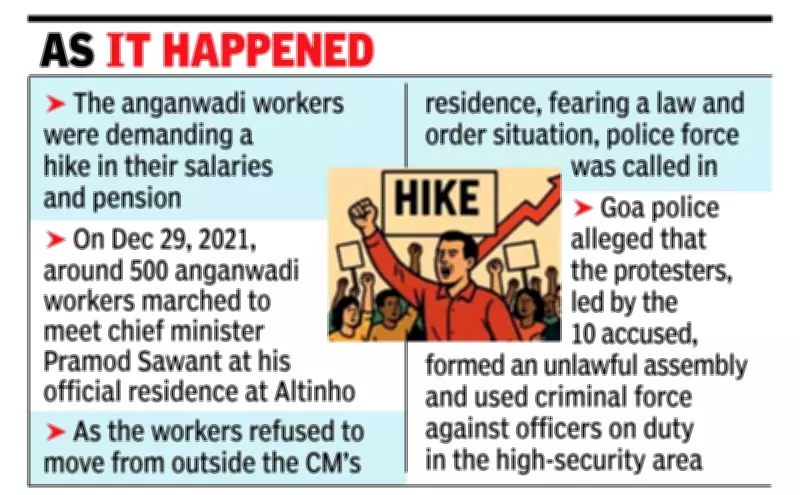
The case originated from a demonstration on December 29, 2021, when approximately 500 anganwadi workers marched to meet Chief Minister Pramod Sawant. Goa police had filed charges against the ten accused, alleging they led an unlawful assembly and used criminal force against officers in the high-security area. Among those charged were Hrudaynath Shirodkar, GFP general secretary Durgadas Kamat, and former Youth Congress president Varad Mardolkar.
Investigation Flaws and Prosecution Arguments Dismissed
The court critically examined the investigation process, noting it relied almost exclusively on "cyclostyle" or repetitive statements from police personnel. A notable finding was the absence of statements from key officials present at the site, such as the executive magistrate or the social welfare director, which the court deemed "tenable" as a significant oversight.
Furthermore, the prosecution's central argument involved claims of physical violence against police, including an alleged tooth bite by an anganwadi protester. However, the court dismissed these allegations due to a complete lack of proof. "The complaint mentions the crowd turned violent and also assaulted a police personnel with a tooth bite by one anganwadi agitator/protester, and that the protesters used criminal force, deterred, and obstructed police force from performing their duty, but there is no evidence of the same," the court observed, underscoring the insufficiency of the prosecution's case.
This ruling highlights the judiciary's role in ensuring that criminal prosecutions are based on concrete evidence, protecting individuals from unfounded charges. The discharge of the activists marks a pivotal moment in this legal saga, reflecting the court's commitment to justice and due process.