

Gujarat Police Most-Wanted List Exposed: Dawood, Chhota Rajan Errors Revealed
A comprehensive district-wise review of Gujarat's official most-wanted list has uncovered a series of embarrassing and significant errors that raise serious questions about data management within the state's police force. The list, intended to catalog dangerous fugitives, contains outdated entries and incorrect information that undermines its credibility and effectiveness.
Dawood Ibrahim's Multiple Incorrect Identities
Most strikingly, the country's most wanted fugitive, underworld don Dawood Ibrahim, appears under three different incorrect names across various district records. Despite being declared a global terrorist by the United Nations Security Council in 2003 with his correct name documented as Dawood Ibrahim Kaskar, Gujarat police records show him as:
- Dawood Ibrahim Meman in Ahmedabad
- Dawood Ibrahim Shaikh in Jamnagar and Surat
- Dawood Ibrahiim Meman in Mehsana (with an extra 'i' in his middle name)
This confusion persists 23 years after international authorities standardized his identity and detailed his links to terror networks including al-Qaida. Even more remarkably, his listed address in official records remains somewhere in Mumbai, despite years of international intelligence consistently placing him abroad.

Chhota Rajan's Inclusion Despite Imprisonment
Equally problematic is the continued inclusion of Chhota Rajan, whose real name is Rajendra Sadashiv Nikalje. Rajan has been in Indian prison since his extradition in 2015, convicted of murder twice - first for the killing of a journalist in 2018, then for the murder of a hotelier in 2024. He is currently serving life sentences.
Despite this well-documented imprisonment, Rajan still appears on the most-wanted lists of Ahmedabad city and Surat, among other districts, categorized as an absconder. Gujarat police have been searching for him for years, apparently unaware of his incarceration status.
Systemic Data Management Failures
Police sources have admitted that these lapses stem from outdated and inefficient data handling systems. A senior officer explained the flawed process: "District units send names of absconders to CID (crime), which compiles the list. In many cases, units appear to have simply copied older records without checking if any of the people on them had since been arrested, convicted, released on bail or died."
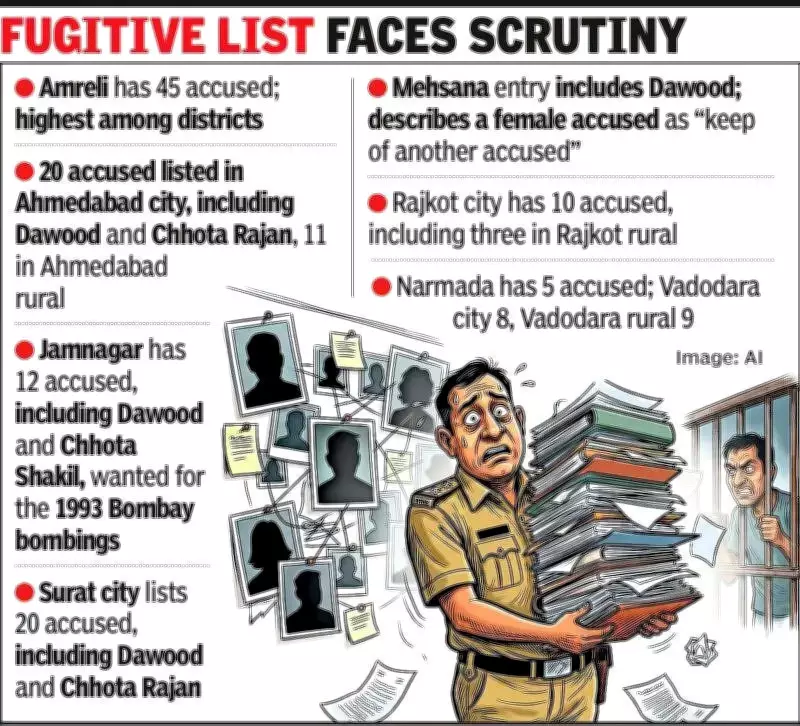
This systemic failure has resulted in a most-wanted list that varies wildly in scale and accuracy across districts. Amreli leads with 45 wanted accused, while Ahmedabad city and Surat each list 20. Districts like Anand, Dahod, Gandhinagar and Junagadh show approximately 10 entries each.
Questionable Entries and Incomplete Information
Among the more questionable entries is a woman wanted in a murder case in Mehsana, who is described in official police records simply as the "keep of another accused." Her name was apparently not considered essential information for inclusion in the most-wanted list.
The revelation of these errors comes at a time when law enforcement agencies are expected to maintain accurate, up-to-date databases to effectively combat crime and terrorism. The discrepancies in Gujarat's most-wanted list highlight significant gaps in inter-departmental communication and data verification processes.
These findings raise concerns about resource allocation and investigative priorities, as police continue to search for individuals who are either correctly identified by international agencies or already in custody. The situation underscores the urgent need for modernization of police record-keeping systems and implementation of regular verification protocols.






