

Punjab and Haryana High Court Rebukes HSSC for Unfair Job Allocation Practices
In a landmark ruling with significant implications for public employment, the Punjab and Haryana High Court has strongly criticized the Haryana Staff Selection Commission (HSSC) for employing an "opaque and arbitrary" approach in assigning government departments to selected candidates. The court's detailed orders, issued by Justice Harpreet Singh Brar, highlight serious violations of constitutional principles of equality and fairness.
Court Finds Misconduct in Allocation Process
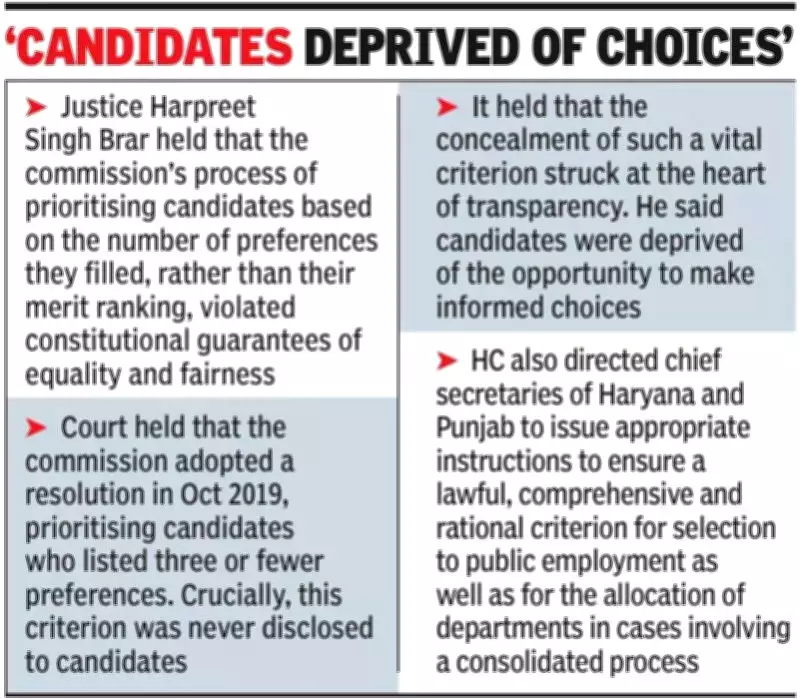
The High Court determined that the HSSC's method of prioritizing candidates based on the number of preferences they listed, rather than their merit ranking, fundamentally undermines the guarantees of equal opportunity. Justice Brar emphasized that this practice creates an uneven playing field, disadvantaging qualified individuals who may have filled out more preferences in good faith.
Further intensifying its scrutiny, the court observed that the current scenario "makes out a clear case of misconduct." In response, it has directed the Haryana chief secretary to thoroughly examine the suitability of launching an inquiry into the conduct of HSSC members and office-bearers. The directive includes assessing the desirability of taking appropriate disciplinary action against those responsible for the flawed process.

Hidden Criteria and Lack of Transparency Exposed
Delving into the specifics, the court revealed that the HSSC adopted a resolution in October 2019, which gave priority to candidates who listed three or fewer department preferences. Crucially, this critical criterion was never disclosed to the applicants. "The concealment of such a vital criterion strikes at the heart of transparency," the court remarked, noting that candidates were effectively deprived of the opportunity to make informed and strategic choices about their career paths.
This lack of disclosure not only misled applicants but also compromised the integrity of the entire recruitment system, raising questions about the commission's commitment to fair practices.
Court Mandates Comprehensive Reforms and Compliance
To prevent such issues from recurring, the High Court has issued a series of directives aimed at overhauling the selection process. It has ordered the chief secretaries of both Haryana and Punjab to issue appropriate instructions ensuring that a lawful, comprehensive, and rational criterion is devised for public employment selections and department allocations. This criterion must be explicitly declared in advance, at the time of issuing recruitment advertisements, to uphold transparency and preserve the integrity of the process.
The court has set a strict timeline for these reforms, requiring the instructions to be issued within three months of receiving a certified copy of the order. Additionally, a compliance report detailing the actions taken must be filed with the court registry before the expiry of this three-month period. Copies of the order have been sent to the respective chief secretaries for necessary implementation and oversight.
Background of the Petition and Unfair Allocations
The High Court's order stems from a petition filed by several candidates who were selected as junior engineers (JE) by the HSSC. These petitioners challenged their departmental allocations, arguing that despite scoring higher marks, they were assigned to less desirable posts. For instance, one petitioner with 65 marks was allocated a lower-preference department, while candidates with lower scores received more sought-after positions, such as in the irrigation and water resources department.
This disparity underscores the arbitrary nature of the allocation process and reinforces the court's findings of systemic unfairness. The ruling serves as a critical reminder of the need for merit-based and transparent procedures in public sector recruitment to uphold justice and equity for all applicants.






