

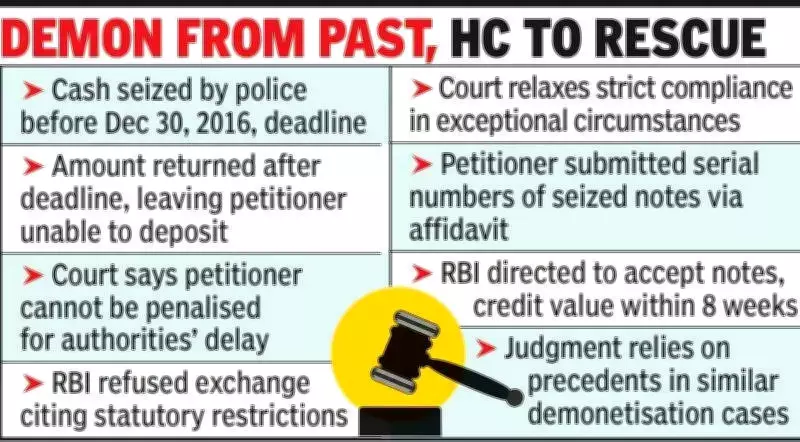
Nearly a decade after demonetisation, the Nagpur bench of the Bombay High Court on Wednesday directed the Reserve Bank of India (RBI) to accept and exchange demonetised currency worth Rs 2 lakh that was seized from an Akola trader in 2016. The court ruled that a citizen cannot be penalised for a delay caused by the authorities.
Court Ruling on Seized Currency
A division bench comprising Justices Urmila Joshi Phalke and Nivedita Mehta allowed the petition filed by Akola-based businessman Girish Malani. The court held that the cash was seized before the December 30, 2016, deadline but was returned only after the cut-off date, leaving the petitioner with no opportunity to deposit it.
Malani challenged the RBI's action through his counsel, CN Deshpande, in the high court. The bench observed: "The specified bank notes were seized prior to the cut-off date prescribed for deposit and were returned to the petitioner thereafter. Since the petitioner has now placed on record the particulars of the said currency notes, we do not find any reason to deny him the benefit of receiving the value thereof in accordance with law."

Background of the Case
The case originated from an incident on December 1, 2016, when police intercepted a trader's vehicle near Mahur during municipal election checks and seized Rs 2 lakh in Rs 500 notes. The amount was later found legitimate by the Income Tax Department and was returned on December 31, 2016 — a day after the deadline for depositing demonetised currency had passed.
Malani approached the RBI in January 2017 seeking to exchange the notes, but his request was denied on the grounds that the statutory conditions under the Specified Bank Notes (Cessation of Liabilities) Act, 2017, and related rules were not fulfilled.
Court's Observations
Rejecting a rigid interpretation of the rules, the court held that the petitioner was deprived of the opportunity to comply due to the authorities' own actions. "He cannot be placed in a disadvantageous position on account of an act for which he is not responsible," the bench observed.
The court noted that although the statutory framework restricts the acceptance of demonetised notes, exceptions must be applied in genuine cases where compliance was rendered impossible. It also found that the petitioner had submitted the serial numbers of the seized notes through an affidavit, addressing a key procedural requirement.
Citing earlier rulings in similar cases, the bench stated that relief cannot be denied where the currency remained in official custody beyond the deadline. The court directed the petitioner to submit the notes to the RBI within one week and ordered the central bank to verify and credit the equivalent value within eight weeks.






