Bombay High Court Emphasizes Right to Speedy Trial, Grants Bail in Child Abduction Case
The Nagpur bench of the Bombay High Court has delivered a significant ruling, stating that the mere filing of multiple bail applications cannot be used as a valid ground to deny relief to an accused person. In a decision that underscores the constitutional right to a speedy trial, the court granted bail to a woman involved in a child abduction case, highlighting the importance of personal liberty under Article 21 of the Indian Constitution.
Court Rejects Argument Linking Bail Pleas to Trial Delays
In an order issued by Justice MM Nerlikar on Tuesday, the court firmly rejected the trial court's reasoning that repeated bail applications contributed to procedural delays. "It can be said that the accused are exercising their statutory right," the court observed, adding that this exercise of legal rights cannot justify continued incarceration. The petitioner had been in custody since November 11, 2022, in connection with a case registered at the Kalamna police station in Nagpur.
The charges against her included Sections 363, 369, 370, and 120-B of the Indian Penal Code, along with provisions of the Juvenile Justice (Care and Protection of Children) Act, 2015. The case involved the alleged abduction of an eight-month-old child by a co-accused known to the victim's family, adding a layer of complexity to the legal proceedings.

Defense and Prosecution Arguments Highlight Constitutional Issues
During the bail hearing, defense counsel Mir Nagman Ali argued for the petitioner's release, citing prolonged incarceration and significant delays in the trial process. He contended that the petitioner's fundamental right to a speedy trial under Article 21 of the Constitution was being infringed, a point that resonated with the court's final decision.
On the other side, public prosecutor PC Bawankule opposed the bail plea, maintaining that the delays were attributable to the repeated applications filed by the accused. The prosecution suggested that the trial be expedited as an alternative to granting bail, but the High Court found this argument untenable in light of established legal principles.
High Court Cites Supreme Court Precedents on Liberty and Justice
Referring to well-established constitutional principles and Supreme Court precedents, the court noted, "If the State has no wherewithal to provide a speedy trial, it should not oppose the plea for bail on the ground that the crime committed is serious." This statement reinforces the judiciary's commitment to balancing the seriousness of offenses with the overarching right to personal liberty, which the court described as "overarching and sacrosanct."
The court meticulously reviewed the timeline of the proceedings, observing that charges were framed only in December 2025, more than three years after the woman's arrest. With no meaningful progress in the trial, the court held that continued detention under such circumstances would be unjustified, leading to the grant of bail.
Bail Conditions and Judicial Warnings
Granting bail, the court directed the woman's release on a personal bond of ₹25,000, subject to strict conditions designed to ensure the integrity of the trial process. These conditions include:
- Refraining from influencing witnesses or tampering with evidence.
- Providing residential details to the police for monitoring purposes.
- Attending all trial dates without fail.
The court issued a clear warning that failure to comply with these conditions, including absence on two consecutive hearings, could result in the cancellation of bail, emphasizing the need for accountability even after release.

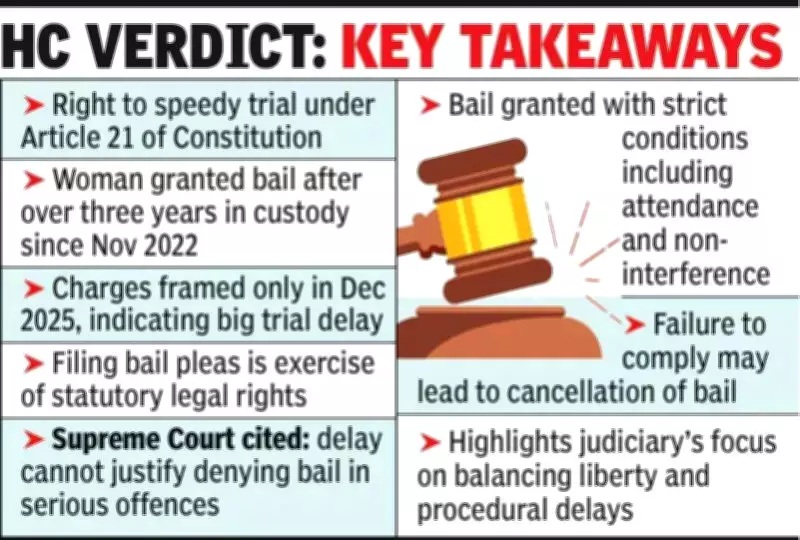
Key Takeaways from the High Court Verdict
- Emphasizes the right to a speedy trial under Article 21 of the Constitution as a fundamental aspect of justice.
- Woman granted bail after over three years in custody since November 2022, highlighting the impact of trial delays.
- Charges framed only in December 2025, indicating a significant and unacceptable delay in the judicial process.
- Court affirms that filing bail pleas is an exercise of statutory legal rights and cannot be used to deny relief.
- Cites Supreme Court precedents: delay cannot justify denying bail, even in cases involving serious offenses.
- Bail granted with strict conditions to ensure trial integrity, including mandatory attendance and non-interference.
- Failure to comply with conditions may lead to cancellation of bail, balancing liberty with procedural safeguards.
- Ruling underscores the judiciary's focus on balancing personal liberty with procedural delays, setting a precedent for future cases.
This landmark decision by the Bombay High Court serves as a reminder of the critical role of the judiciary in upholding constitutional rights, particularly in ensuring that delays in the legal system do not undermine the fundamental principles of justice and liberty. By granting bail in this child abduction case, the court has reinforced the importance of a timely trial and the protection of individual freedoms within the framework of Indian law.