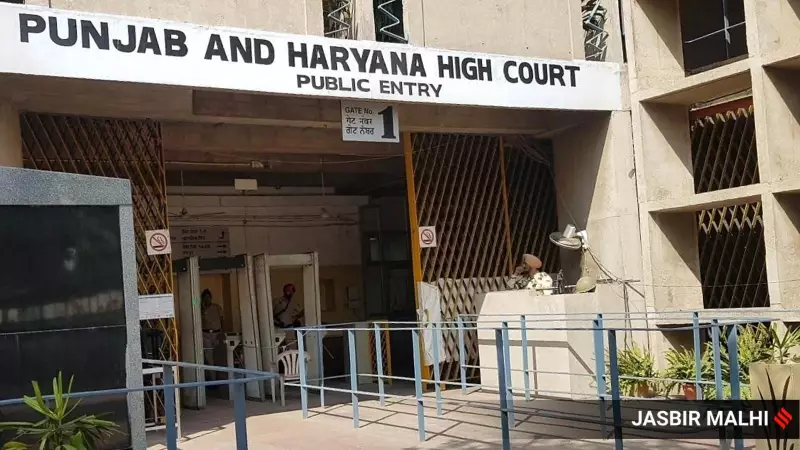
The Punjab and Haryana High Court has delivered a landmark judgment, directing the Punjab government to pay a lump-sum compensation of Rs 5 lakh to a worker who was retrenched from a state hydel project nearly four decades ago. The court strongly criticized the state for its "administrative apathy" and for failing to act as a model employer, a principle it called a constitutional mandate.
A Protracted Legal Battle Spanning Decades
The ruling, pronounced by Justice Harpreet Singh Brar on November 20, 2025, brings partial closure to a legal struggle that began in the 1980s. The case centers on Mohan Lal, who was appointed as an earth work mistri at the Anandpur Sahib Hydel Project (ASHP) on September 10, 1978. His services, along with those of many others, were terminated on July 31, 1985, following the project's completion.
Although Lal received retrenchment compensation as per the Industrial Disputes Act, 1947, he and other workers challenged their termination. In 1986, the High Court initially allowed their petitions, but the state appealed. A division bench, in its judgment dated January 12, 1989 in the case of State of Punjab vs Mehanga Ram, set aside the relief but issued crucial directions for the absorption of the retrenched employees.
State's Undertaking and the Equality Argument
Lal's counsel, R K Gautam, argued that his client was covered by the 1989 absorption directions. He also highlighted a significant undertaking given by the Advocate General of Punjab before the Supreme Court on August 4, 1995, promising to issue appointment letters to the terminated ASHP employees. Gautam contended that denying Lal this benefit while granting it to others violated the constitutional rights to equality under Articles 14 and 16.
The state's counsel, Vikas Arora, and other respondents' counsel, Vishal Gupta, opposed the plea. They argued that Lal was retrenched in 1985 and was not in service when a relevant policy was framed in 1993. They also pointed out that Lal was not a direct party to the Supreme Court proceedings and raised an objection regarding the delay in filing the petition in 1997.
Court's Scathing Observations and Final Order
Justice Brar, however, found merit in Lal's arguments, holding that his case fell within the class of workers covered by both the 1989 directions and the 1995 undertaking. The court dismissed the delay plea, noting the petition was filed after obtaining liberty from the Supreme Court.
In powerful observations, the judge stated, "The very essence of a welfare state, as envisioned by our Constitution, is compromised when the instrumentalities of the state itself become a source of protracted litigation." He emphasized that the principle of the state being a model employer is a constitutional mandate, not a mere platitude.
Given the long lapse of time and Lal's age, the court deemed reinstatement impractical. Relying on Supreme Court precedents, it noted that when an employee is not at fault and is kept out of work due to the employer's actions, denying them justice is unfair. The court concluded that Lal endured significant hardship due to the state's "recalcitrance."
Disposing of the petition, the High Court directed the Punjab government to release the Rs 5 lakh compensation within three months of receiving a certified copy of the order, finally providing a measure of redressal for the decades-long injustice.