High Court Orders Immediate Sealing of Illegal Mining Site in Haryana's Charkhi Dadri District
The Punjab and Haryana High Court has expressed grave concern over what it described as "rampant loot and plunder of natural resources" through illegal mining activities in Haryana's Charkhi Dadri district. In a strongly worded order released on Monday, the court has directed the state government to immediately seal the mining site and submit detailed explanations for the extensive environmental damage caused.
Court Questions Mining Closure Order as Possible "Cover-Up"
A division bench comprising Justice Ashwani Kumar Mishra and Justice Rohit Kapoor questioned a mining closure order produced by the state during the hearing. The bench termed this document a potential "cover-up" aimed at legitimizing past violations under the guise of economic unviability rather than addressing serious environmental breaches.
"The chief secretary, government of Haryana, will ensure that the entire mining area is sealed. The sealing operation will be undertaken within 48 hours by Charkhi Dadri deputy commissioner himself and the entire process will be videographed," the bench stated in its comprehensive order.

Regulatory Oversight "Prima Facie Failed" According to Court
The bench raised serious questions about the conduct of government officials, observing that regulatory oversight had "prima facie failed" and that connivance between officials and mining operators could not be ruled out. The court noted that despite numerous reports of accidents, landslides, and unsafe mining practices, effective administrative action was significantly delayed until judicial intervention forced the issue.
Directions have been issued to the Haryana chief secretary to examine the matter thoroughly and file a 'personal affidavit' specifying how the state proposes to deal with the vast extent of environmental destruction. "Not only the responsibility of private individuals but also those officials who were entrusted with compliance of laws and have defaulted in doing so, will have to be appropriately determined and dealt with as per law," the High Court emphasized.
Petition Reveals Extensive Environmental Damage
The division bench passed these orders while hearing a petition filed by residents of Pichopa Kalan village, including operators of a stone crusher unit. The petitioners alleged large-scale illegal and unsafe mining by a private leaseholder extending far beyond the sanctioned mining area.
The petitioners claimed that illegal mining had:
- Destroyed natural hillocks completely
- Caused significant ecological imbalance
- Endangered human lives through unsafe practices
- Deprived landowners of approximately Rs 9 crore worth of compensation
Senior advocate Shailender Jain, assisted by advocate Vikrant Rana, representing the petitioners, submitted that "the hillocks that once existed on the land have disappeared." The petition further stated that several complaints had been filed with the mining officer and district collector, adding that mining operations were being carried out up to 50 feet below the groundwater table.
Commissioner's Report Confirms Serious Violations
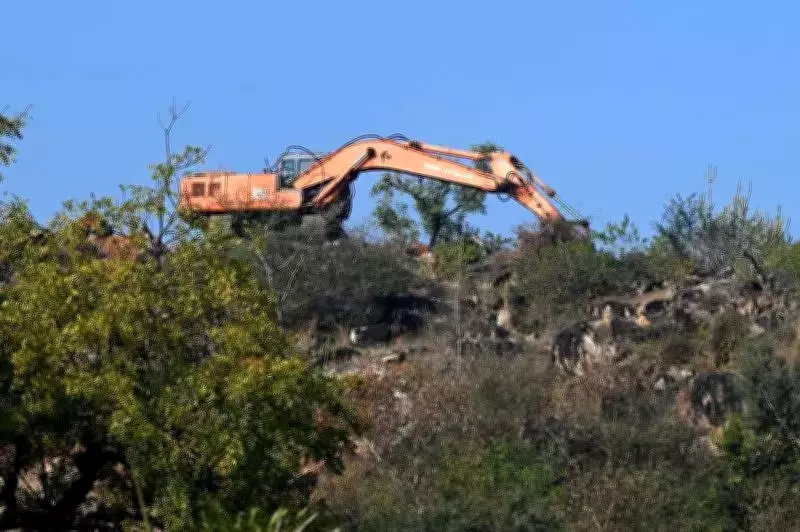
The bench had earlier appointed an advocate commissioner to inspect the site. The commissioner's report, supported by comprehensive drone mapping and photographic evidence, confirmed all allegations. The investigation revealed:
- Deep pits filled with water from excessive excavation
- Missing boundary pillars indicating unauthorized expansion
- Unstable slopes creating landslide hazards
- Mining activity extending far beyond the approved lease area
The High Court noted that the mining lease, granted in 2016 for 11 hectares of land classified as 'gair mumkin pahad' (hill land) in the environmentally sensitive Aravalli range, was found to be in "serious violation of environmental clearance conditions and the approved mining plan."
The court observed that mandatory environmental safeguards including:

- Proper benching of excavation sites
- Buffer zones for ecological protection
- Compensatory plantation requirements
- Groundwater protection measures
- Safety fencing around mining areas
were "completely absent" on the ground, indicating systematic disregard for environmental regulations.
Ministry of Environment Made Party to Case
The Ministry of Environment, Forest and Climate Change has been made a party in this significant case, with directions to suggest comprehensive remedial measures to prevent similar environmental degradation in the future. This inclusion underscores the national importance of addressing illegal mining practices that threaten India's fragile ecosystems.
The next hearing in this crucial environmental case has been scheduled for February 25, when the court will review compliance with its sealing orders and examine the state government's proposed measures for environmental restoration and accountability.