

Bombay High Court Overturns PMC Orders, Paves Way for ACB Inquiry
In a significant legal development, the Bombay High Court has quashed and set aside orders issued by the Pune Municipal Commissioner on April 16 and 25, 2019. These orders had previously rejected a request for an open inquiry by the state Anti-Corruption Bureau (ACB) against former city engineer Prashant Waghmare. The allegations center on Waghmare amassing assets disproportionate to his known sources of income.
Court Ruling on Prior Approval Requirement
A bench comprising Justice AS Gadkari and Justice Ranjitsinha Raja Bhonsale delivered the ruling on April 2. The court held that prior approval for an open inquiry in a disproportionate assets case is not mandatory. The bench found that the PMC chief, acting as the Competent Authority, exceeded his jurisdiction by conducting a hearing and delving into the details of the matter to deny the approval plea.
The bench emphasized, "After conducting the open inquiry, the authorities will follow the procedure and process as envisaged in the Prevention of Corruption Act and take swift and appropriate action in accordance with law." This directive ensures that the ACB must approach the competent authority again for prosecution sanction only if the open inquiry uncovers prosecutable evidence against Waghmare.

Legal Implications and PMC's Response
Following the ruling, the PMC's lawyer requested a stay, which the bench granted for two weeks to allow the civic administration to file an appeal with the Supreme Court. Advocate Abhijit Kulkarni, representing the PMC, stated that the appeal is necessary due to the statewide ramifications of the judgment. He argued that the PMC chief's orders were aligned with a Government Resolution from March 3, 2015, which empowers the competent authority to conduct an inquiry before granting or rejecting prior approval.
Kulkarni expressed concern that the ruling could lead to multiple third-party individuals using disproportionate assets inquiries as tools to harass or pressure government officials. This highlights the broader legal and administrative challenges posed by the court's decision.
Background of the Case
The case originated from a petition filed by activist Tanaji Gambhire in 2021, alleging that the PMC was protecting Waghmare, who had allegedly accumulated wealth worth multiple crores of rupees disproportionate to his income. The bench clarified the role of the competent authority under section 17(A) of the Prevention of Corruption Act, stating it should only verify if collected material merits an inquiry, without conducting hearings or mini-trials.
The court noted, "The competent authority has no authority to usurp the powers of the authorized Inquiry Officer under section 17 of the PC Act or the power to grant or refuse sanction to prosecute under section 19 of the PC Act." This reinforces the separation of functions in corruption investigations.
Timeline of Key Events
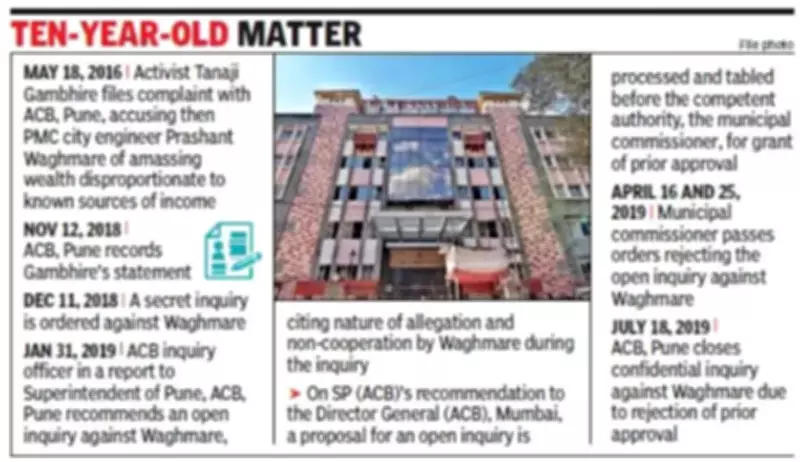
- May 18, 2016: Activist Tanaji Gambhire files a complaint with the ACB, Pune, accusing Prashant Waghmare of disproportionate assets.
- November 12, 2018: ACB records Gambhire's statement.
- December 11, 2018: A secret inquiry is ordered against Waghmare.
- January 31, 2019: ACB inquiry officer recommends an open inquiry, citing allegations and Waghmare's non-cooperation.
- April 16 and 25, 2019: Municipal commissioner rejects the open inquiry.
- July 18, 2019: ACB closes the confidential inquiry due to the rejection of prior approval.
This ruling marks a pivotal moment in anti-corruption efforts, potentially streamlining future inquiries into disproportionate assets cases by reducing bureaucratic hurdles.






