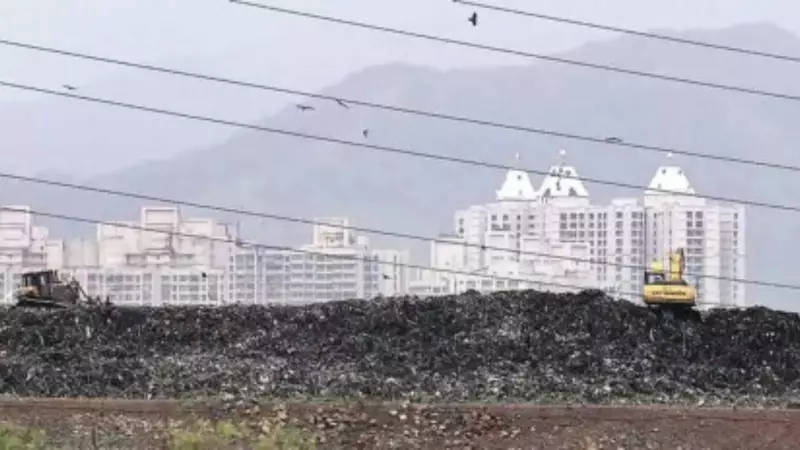
The Bombay High Court on Monday issued a stern directive to the Maharashtra government, demanding immediate short-term measures to tackle the severe pollution and health hazards emanating from the Kanjurmarg municipal solid waste dumping site. The court emphatically declared that the 'right to breathe fresh air' is an integral part of the fundamental right to life guaranteed under Article 21 of the Constitution.
A 'Situation of Emergency' for Mumbai's Suburbs
A division bench of Justices Girish S Kulkarni and Aarti A Sathe was hearing a Public Interest Litigation (PIL) filed by the environmental NGO Vanashakti. The bench observed that the foul odour from the dumping ground was causing 'serious health concerns' for residents and contributing significantly to urban pollution, creating a 'situation of emergency.' The court expressed dismay that the Municipal Commissioner did not appear to be treating the issue with the urgency it warranted.
The judges noted their deep concern for the adverse impact of hazardous pollution violating citizens' basic rights. 'We want a healthy population. There should be respite for citizens,' the bench stated orally, pointing out that the odour was now affecting suburbs as far as Mulund and Ghatkopar.

Court Directs Immediate Action and 24x7 Grievance Redressal
Additional Government Pleader Jyoti Chavan informed the court that a committee, formed following the HC's December 11 order, had inspected the site on December 21. She revealed that the site receives nearly 6,500 metric tonnes of waste daily, accumulating to about 2.1 lakh metric tonnes monthly, with contractors using bio-enzymes to control the smell.
Unsatisfied with mere reports, the court directed the committee to file an affidavit detailing immediate short-term measures to stop the odour pollution and redress the harm to public health. The bench stressed that 'no dumping ground can be permitted to operate in a manner which would breach such basic human rights of the citizens.'
Furthermore, the High Court mandated the establishment of an effective, round-the-clock grievance redressal system. The Brihanmumbai Municipal Corporation (BMC) must notify dedicated mobile numbers and email IDs where citizens can lodge complaints, with a response guaranteed within one hour.
Long-Term Contract and Contractor Accountability Under Scrutiny
The court also raised serious questions about the long-term contract for waste processing at the site, which runs from 2011 to 2036. It highlighted the 'uncertainty on measures taken to scientifically, efficiently and effectively remedy the problems' raised by petitioners over years.
Justice Kulkarni pointed out that with population growth, waste will increase monumentally, and technology evolves. 'The contractor is simply running his business at the cost of breathing problems etc. Do not make it a commercial venture,' the court warned, indicating it might issue specific directions if the situation does not improve.
The bench reiterated that the contractor is 'accountable to the public at large.' It emphasized the critical need for segregation of wet and dry waste across Mumbai as a foundational solution. Drawing a parallel, the court remarked on the alarming pollution scenario in Delhi and stated that the right to breathe fresh air cannot be compromised.
The matter has been posted for further hearing on December 24, by which time the panel's affidavit on immediate actions is expected. The panel will also seek assistance from an expert from IIT-Bombay to formulate solutions.