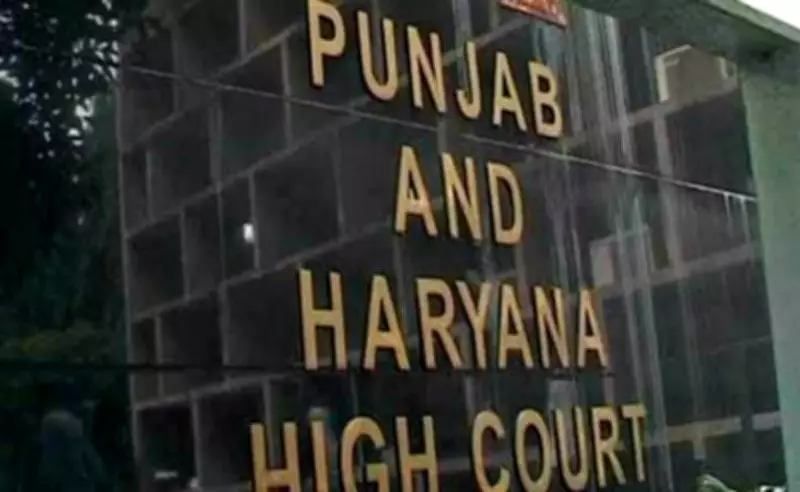
The Punjab and Haryana High Court has ruled that courts cannot substitute the opinion of subject experts unless the alleged error in the answer key is glaring, manifest, and beyond doubt. The court also held that in case of ambiguity or doubt, the benefit must go to the examination authority rather than the candidate.
Case Background
Justice Jagmohan Bansal dismissed a batch of petitions challenging the Haryana Civil Services (Executive Branch) preliminary examination result and answer key. The court observed that the Haryana Public Service Commission (HPSC) had acted “in a bona fide and transparent manner” and any interference at the instance of a few unsuccessful candidates would stall the entire selection process.
The petitions challenged the preliminary examination result dated May 4 for recruitment to HCS (Executive Branch) and allied services conducted on April 26 pursuant to an advertisement dated January 30.

Examination Process
The court noted that after the examination, the HPSC uploaded the provisional answer key on April 28 and invited objections from candidates. The objections were referred to subject experts, who modified answers to certain questions. A revised answer key was uploaded on May 2, and the result was declared on May 4.
The petitioners argued that answers to several questions in the General Studies paper and the Civil Services Aptitude Test were wrong and contrary to authentic material. They specifically challenged questions 17, 30, 31, 32, 59, and 80 in the General Studies examination and questions 6 and 8 in the aptitude test.
Court's Observations
During the hearing, the court directed the HPSC Secretary to file an affidavit after obtaining comments from the expert committee. The Commission informed the court that objections were reconsidered and a second opinion from experts was obtained after the High Court’s interim order. However, the experts did not recommend any further change in the final answer key.
The petitioners contended that the revised answer key was finalised without granting them an opportunity to file cross-objections. They relied on the High Court judgment in Ramandeep Kaur versus Council of Scientific and Industrial Research (CSIR) to argue violation of fairness. They also asserted that the Commission and the court were required to independently apply their mind and not mechanically accept the experts’ opinion.
Opposing the petitions, the HPSC maintained that all objections had been referred to subject experts and the Commission, not being an expert academic body itself, was entitled to rely on their opinion. It further argued that there was no rule requiring candidates to be confronted with objections filed by others before the answer key was finalised.
Legal Principles
Justice Bansal extensively referred to Supreme Court precedents governing judicial review in examination matters. The bench quoted judgments stating that the burden is on the candidate to demonstrate not merely that the answer key is incorrect, but that it contains a glaring mistake apparent without inferential reasoning. Constitutional courts must exercise “great restraint” while entertaining challenges to answer keys.
The High Court also relied on another Supreme Court matter, wherein the court held that courts should not re-evaluate answer sheets, academic matters should be left to experts, and in the event of doubt the benefit should go to the examination authority rather than the candidate.
Court's Decision
Applying these principles, the High Court held that the objections raised by candidates had been duly considered by subject experts and the disputed questions had again been referred for reconsideration after interim directions. The experts reiterated their earlier view.
The court held: “On examination of final answer key prepared by the Commission and answers suggested by petitioners, it comes out that it cannot be conclusively held that answers suggested by subject experts are manifestly incorrect. Thus, there is no scope to substitute opinion of subject experts.”
The High Court specifically observed that there was “doubt with respect to answer to Question 59” relating to the Haryana Parivar Pehchan Act, 2021, but held that in view of settled law, “benefit of doubt must be extended to the Selection Commission”.

Rejecting the plea, Justice Bansal observed that accepting the petitioners’ contention would create a “never-ending process of raising objections” making it impossible for the Commission to finalise the recruitment process.
The court also took into account that the examination under challenge was only a preliminary examination and the final examination was “going to take place in the end of this month”. It observed that interference at the instance of a few unsuccessful candidates would stall the entire selection process and would be “precarious for the public at large as well as candidates who have been selected for the final exam”.