

South Africa's Indian Community Confronts Racism and Identity Questions
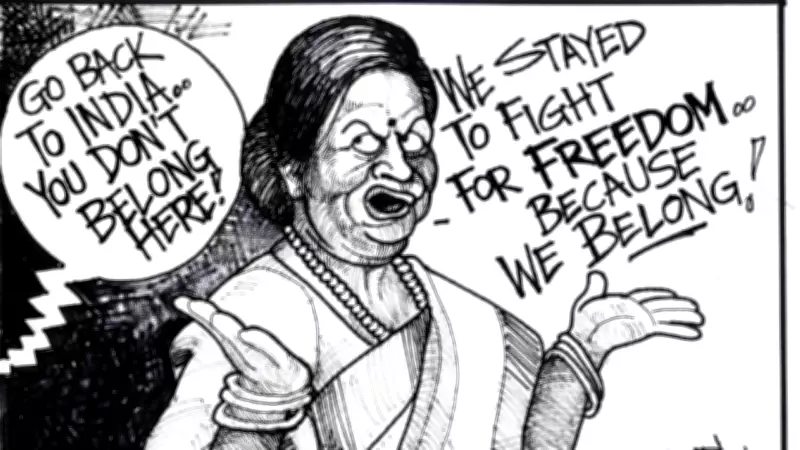
In December, a disturbing video circulated widely across social media platforms, capturing a troubling incident of racial abuse. The footage showed a South African woman, identified as a former airline employee, launching a torrent of verbal abuse at a fellow passenger during a flight. Her inflammatory remarks included telling the individual to "go back to India" while making offensive comments about Indians and the Taj Mahal.
The woman explicitly stated, "I work at the airline... Every time there are Indians on the Durban flights, you guys smell like sh*t. Go back to India." The airline involved promptly confirmed her former employment status and issued a strong condemnation of both the video content and the racist sentiments expressed.
Multiple Incidents Fuel Racial Tensions
Around the same period, another inflammatory TikTok video emerged targeting Indian South Africans, coinciding with Prime Minister Narendra Modi's visit for a G20 summit. This recording suggested that South Africans of Indian origin "have another country to go to," further inflaming racial tensions. Fanle Sibisi, spokesman for the African National Congress in KwaZulu-Natal, denounced the content as "racist and ignorant."

These incidents have brought renewed attention to the complex position of South Africa's Indian community, numbering approximately 1.5 million people with significant concentration in KwaZulu-Natal. More than three decades after the country's democratic transition in 1994, descendants of indentured laborers and traders who arrived beginning in the 1860s find themselves at a critical juncture, examining their role and relevance in contemporary South African society.
Constitutional Protections Versus Daily Realities
While the South African constitution explicitly protects Indian residents, many community members express discomfort about their standing due to sporadic racist incidents and affirmative action policies. Some argue these laws create barriers to government employment and public education opportunities for Indian South Africans.
The viral airplane incident underscores broader challenges facing not just Indian South Africans but all minority communities in post-apartheid South Africa. It reveals persistent racial prejudice, fragile social cohesion, and the urgent need for institutional reforms and community-led initiatives to address these issues.
Democratic Resilience Amid Social Fragility
The Institute for Justice and Reconciliation's 2025 South African Reconciliation Barometer, based on 2,006 interviews, presents a nation demonstrating democratic resilience alongside significant public fragility. Despite a peaceful transition to multi-party coalition governance following the 2024 elections, public trust in political leaders and institutions remains concerningly low.
Social cohesion indicators suggest that while national identity remains strong, interpersonal trust is particularly weak across racial and linguistic groups. ANC spokesman Fanle Sibisi emphasized South Africa's constitutional democracy, grounded in principles of equality, dignity, and non-racialism, while condemning attempts to divide communities. He notably highlighted India's prominent historical role in opposing apartheid, including being the first country to sever trade relations with South Africa in 1946.
Historical Context and Contemporary Challenges
The Indian community's presence in South Africa dates to 1860 when British colonial authorities brought indentured laborers to work on sugarcane plantations. Later arrivals included "passenger" Indians who came as traders. Over generations, Indians have significantly influenced South African culture, politics, and cuisine while maintaining diverse religious and linguistic identities.
During apartheid, Indians were classified as a separate racial group, facing discrimination but with legal standing distinct from Black Africans. The community played crucial roles in the anti-apartheid struggle, with notable figures including Ahmed Kathrada, Yusuf Dadoo, and Mahatma Gandhi during his early years in South Africa.

The 1994 democratic transition brought hopes for a "rainbow nation" with constitutional guarantees of equality and non-racialism. Indians contributed significantly to nation-building and liberation efforts. However, apartheid's legacy—segregation, mutual suspicion, and structural inequality—remains deeply embedded in society.
Community Perspectives on Racism and Identity
Sham Maharaj, a respected community voice from Phoenix north of Durban, observes that racism has not disappeared after thirty years of democracy. He notes that racism exists across all racial groups, with minority communities increasingly experiencing hate speech and discrimination. While acknowledging the Indian community's substantial contributions to liberation and nation-building, Maharaj points to tribal politics, nationalist parties, and corruption as factors eroding faith in leadership.
Shameen Thakur-Rajbansi of the Minority Front political party notes that while overt racism has been outlawed, latent prejudice persists and has intensified over the past decade. Social media platforms have amplified racist expressions, and politicians frequently employ racial rhetoric during election campaigns. Thakur-Rajbansi emphasizes that Indians, despite political and economic marginalization, remain integral to South Africa's democratic fabric.
Ela Gandhi, granddaughter of Mahatma Gandhi, identifies comments against the Indian community as part of a disturbing trend of prejudice based on ethnicity, class, and religion. She advocates for self-reflection, empathy, and bridge-building across communities to realize the rainbow nation ideal.
Affirmative Action and Social Cohesion
ANC member Ravin Singh highlights constitutional protections while regarding affirmative action and Black economic empowerment as forms of positive discrimination addressing historical injustice. He acknowledges legitimate concerns about empowerment policies but stresses the necessity of deliberate interventions to dismantle entrenched power structures. Singh notes South Africa's profound inequality complicates social cohesion but points to everyday coexistence and enduring values of ubuntu and seva across communities.
Singh observes greater social cohesion among younger South Africans who carry less historical baggage than older generations. While prejudice persists, distinguishing between latent prejudice and explicit racism remains important. Young Black professionals, including Indians and Coloured people, actively engage in addressing community challenges and confronting prejudice directly.
Youth Perspectives and Future Directions
Neeshan Balton, executive director of the Ahmed Kathrada Foundation, asserts that racism against any community constitutes an assault on democracy, emphasizing the longstanding contributions of Indian South Africans to both anti-apartheid struggles and democratic building.
Publisher Nirode Bramdaw, a former ANC official, notes the pivotal role Indians played in anti-apartheid efforts, recognized by Nelson Mandela's inclusion of five individuals of Indian descent in his first democratic cabinet. Bramdaw argues that race relations have deteriorated, with the ANC increasingly mired in tribalism.
Embracing Dual Heritage
For many Indian South Africans, the answer to identity questions may lie in embracing both aspects of their heritage rather than choosing between them. Paige-Emma Murugan, a teenage schoolgirl of Indian descent in Johannesburg, offers a personal perspective: "South Africa is where I was born. My identity is layered—Indian roots, South African soil, and people from different backgrounds guiding me. That's why I struggle when people ask me to choose between being Indian first or South African first."
She continues, "My birth itself shows I'm both. South Africa gave me life, but India gave me heritage. One is the ground I stand on, the other is the history I carry. Together, they make me whole. If I try to separate them, I lose something important. So I don't choose. I blend. I balance. I carry all of it proudly."
Murugan concludes, "What makes me whole is the mix of all these in my South African melting-pot life—my Christian faith and my Indian heritage living side by side within me. That's who I am."
