

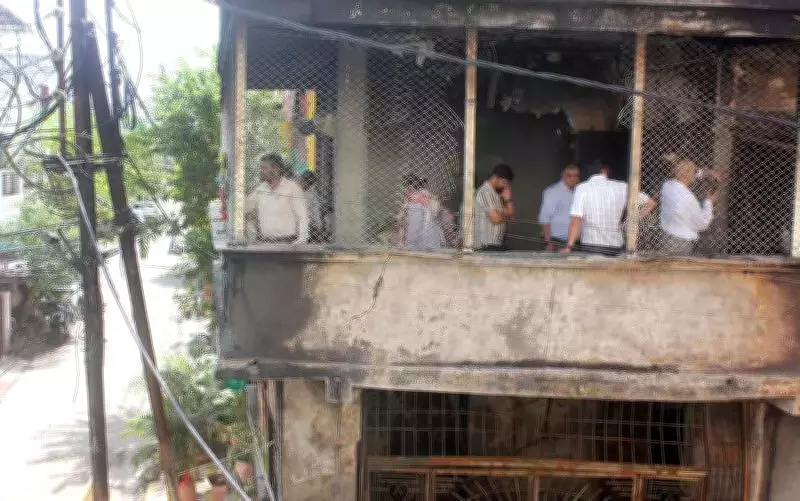
Indore Fire Tragedy: Power Delay and Conflicting Blaze Origin Claims Under Intense Scrutiny
A devastating fire at Arham Villa in Brijeshwari Annexe, Indore, which claimed the lives of eight members of the Pugalia family, has triggered a rigorous investigation. Authorities are focusing on two critical aspects: a significant delay in disconnecting the electricity supply and conflicting accounts regarding the source of the blaze. These factors are believed to have exacerbated the tragedy, complicating rescue efforts and intensifying the fire's spread.
Delayed Power Disconnection Hampered Rescue Operations
Neighbors and rescuers have raised serious concerns about the electricity supply not being snapped for nearly two hours after the fire broke out. This delay created hazardous conditions for firefighters and volunteers attempting to save lives. Bharat Jain, a neighbor who courageously helped rescue family members using a ladder, provided a crucial statement to police. He recounted that firefighters faced dangerous electric currents while trying to douse the flames with water, forcing him to rush to the electricity department office in Scheme No 140 to personally request the disconnection.
Jain also highlighted the peril of using water on what appeared to be an electrical fire, a point that underscores the need for proper emergency protocols. The presence of live electricity during firefighting operations not only put responders at risk but also contributed to the fire's escalation, as subsequent blasts from more than a dozen commercial gas cylinders inside the house further fueled the inferno.

Divergent Claims Over the Origin of the Blaze
Investigators are grappling with conflicting narratives about how the fire started. The power department has suggested that an electric vehicle (EV) parked near an electric pole may have triggered the incident. In contrast, the Pugalia family and several eyewitnesses maintain that sparking from the pole itself was the cause. These witnesses told police they observed sparks and heard cracker-like sounds before flames rapidly engulfed vehicles and spread through all three floors of the building.
An expert team has already examined the EV involved, inspecting its engine area, collecting samples, and documenting the vehicle for forensic analysis. However, Additional DCP Amarendra Singh emphasized that the investigation cannot rely solely on statements from family members and neighbors. It must be corroborated with scientific evidence and expert opinions to establish a definitive sequence of events.
Investigation Progress and Future Steps
Police are meticulously reconstructing the events based on statements from key survivors, including Sunita, her son Saurabh, and a younger family member. These testimonies are considered central to understanding how the fire started and spread with such alarming speed. So far, police have recorded statements from over a dozen individuals, including neighbors and those involved in rescue operations.
Initial findings point toward a short circuit as the likely cause, but Singh indicated that a specialized probe may be initiated for a more detailed analysis. This comprehensive approach aims to address the divergent claims and ensure that all factors—from the delayed power disconnection to the origin of the blaze—are thoroughly examined to prevent such tragedies in the future.
The tragedy has underscored critical issues in emergency response and electrical safety, prompting calls for stricter enforcement of safety norms and quicker coordination between utility departments and fire services during crises.






