

Magisterial Inquiry Launched into Ghaziabad Police Encounters of Two Brothers
A magisterial inquiry has been officially initiated by the Ghaziabad district administration to investigate the police encounters that resulted in the deaths of two brothers, Ghulfam and Zeeshan. These individuals were the prime suspects in the attack on businessman and YouTuber Saleem Wastik. The inquiry, mandated by the National Human Rights Commission (NHRC), aims to conduct a thorough and time-bound probe into the incidents that occurred on March 1 and March 3.
Background of the Encounters
According to police reports, the brothers, who worked as carpenters and resided in Khoda Colony, were identified through CCTV footage after Saleem Wastik was stabbed multiple times at his office in Loni on February 27. The footage allegedly showed the two riding away on a motorcycle moments after the attack, with blood stains visible on their clothes.
On March 1, a police patrol team in Loni signaled a motorcycle carrying Zeeshan and another man to stop. The duo allegedly attempted to flee, leading to a brief chase. Police stated that Zeeshan opened fire during the exchange, resulting in him being shot and collapsing on the road. He was declared dead on arrival at a nearby hospital. More than eight rounds were fired in this incident, and two head constables, Sachin and Nitin, sustained injuries.

Two days later, on March 3, the SWAT team and crime branch tracked Ghulfam near Indirapuram. Police Commissioner J Ravindra Goud reported that at 9:20 PM, Ghulfam was spotted riding from the Vasundhara side. When police attempted to intercept him, the riders sped away, but their motorcycle skidded on a mud mound during the chase, throwing them off. The men allegedly opened fire, injuring head constables Pushpendra Kumar Shukla and Sandeep Kumar. Bullets also struck the bulletproof jackets of ACP (crime) Amit Saxena, sub-inspectors Puran Singh and Bobby Singh, while another round passed close to SWAT in-charge Anil Kumar's ear. Police returned fire, injuring Ghulfam, who later died that night.
Details of the Magisterial Inquiry
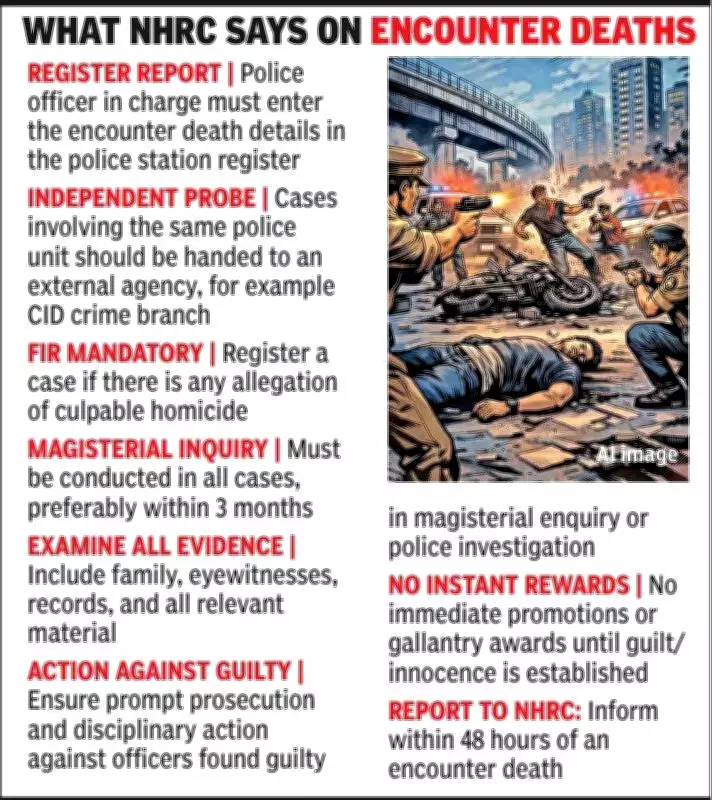
District Magistrate Ravindra Mandar has appointed City Magistrate Santosh Upadhyay to lead the inquiry, directing a comprehensive investigation into the encounters. Officials confirmed that the probe was ordered in compliance with NHRC guidelines, which require an independent inquiry in cases of deaths during police action.
Upadhyay stated, "As per procedure, a public notice was issued on March 17 calling for any information. Following this, we will visit the spot, carry out inspections, and also conduct an inquiry on the officers involved in the encounters. Thereafter, a report will be submitted to the DM, who will then send it to the NHRC."
The city magistrate has invited members of the public to share any direct or indirect information, including written statements, photographs, or audio-visual evidence, by March 31 at the collectorate office or through the notified contact number. The inquiry is expected to be completed within a month and will examine the circumstances leading to the encounters and the actions of the police teams involved.
Legal and Human Rights Implications
Ghaziabad-based human rights activist Rajeev Sharma emphasized that the district magistrate must inform the NHRC within 48 hours of any death caused by police action or in custody. He noted that if the magisterial inquiry later concludes an encounter was staged, an FIR must be registered against the involved police personnel under provisions of culpable homicide. The NHRC typically reviews such reports and recommends compensation for the victim's family, along with further actions like suspension and criminal proceedings.
In a May 2010 communication to all chief ministers, the NHRC reiterated that police have no inherent right to take a life. A death caused by a police officer amounts to culpable homicide unless it is legally justified. The commission clarified that such use of force may be justified only under two conditions: the right to private defence, or when necessary to arrest a person accused of an offence punishable with death or life imprisonment under Section 46 of the erstwhile Criminal Procedure Code, now BNSS.

The NHRC order stated that whether an encounter killing meets these legal thresholds can only be determined through a proper and independent investigation, underscoring the importance of this magisterial inquiry in Ghaziabad.





