

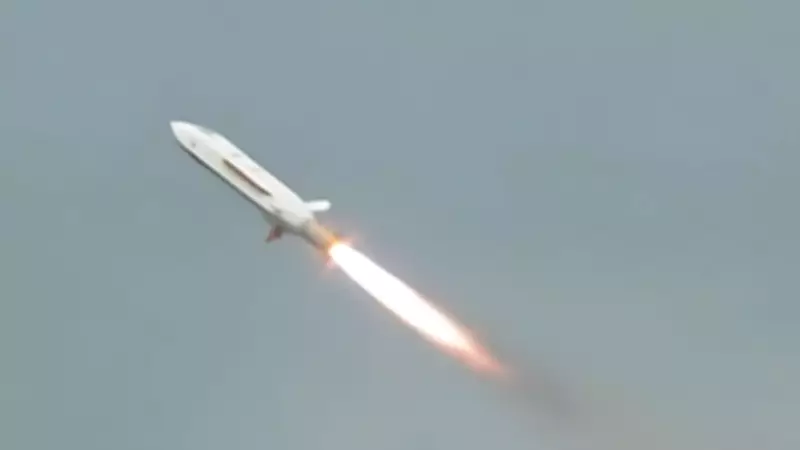
Japan's Type-12 Missile Deployment Reshapes Regional Strategy, Challenges China
Japan has strategically deployed its domestically produced Type-12 long-range surface-to-ship missiles near the East China Sea, a move that analysts assert could compel Beijing to reassess its operational planning regarding Taiwan and broader regional dynamics. This deployment is widely interpreted as crossing a strategic threshold, with significant implications for deterrence and military calculations in the area.
Confirmation and Acceleration of Deployment
Chief Cabinet Secretary Minoru Kihara confirmed on Monday that the upgraded missiles would be operational at Camp Kengun in Kumamoto Prefecture by the end of March. Reports indicate that army vehicles transporting the first batch of missile launchers arrived at the base past midnight, as noted by SGMP. This action follows a 2024 decision by the Japanese Ministry of Defence to advance the missile deployment schedule by one year, driven by escalating military tensions with Beijing in the East China Sea and near Taiwan.
Capabilities and Strategic Impact of Type-12 Missiles
The Type-12 missile, developed and manufactured by Mitsubishi Heavy Industries, boasts an extended range of approximately 1,000 kilometers, a substantial increase from its previous 200-kilometer range. This enhancement allows Japan to cover nearly the entire East China Sea from Kyushu and reach coastal cities in mainland China. The missile is designed to deter Chinese naval vessels in potential conflict scenarios, marking a pivotal shift in Japan's defence posture.

Experts highlight the strategic ramifications of this deployment. John Bradford, executive director of the Yokosuka Council on Asia-Pacific Studies and a former US Navy officer, described it as a new upgrade that enables Japan to threaten Chinese naval ships throughout the East China Sea. He explained that this creates a mutual sea denial scenario, where both China and Japan can target each other's ships, thereby strengthening deterrence and making both sides hesitant to use force.
Ray Powell, director of the SeaLight maritime transparency programme and a retired US Air Force colonel, noted that the deployment integrates into a growing allied missile network along the first island chain. This complicates Beijing's military calculations and enhances Japan's role in alliance burden-sharing, as Tokyo transitions from reliance on the US to wielding its own credible deterrent.
Chinese Response and Escalating Tensions
China has sharply criticised the deployment, with Jiang Bin, spokesperson for the Chinese Defence Ministry, accusing right-wing forces in Japan of accelerating moves towards remilitarisation. Jiang argued that Tokyo's deployment of long-range offensive weapons strips away the disguises of an exclusively defence-oriented policy, labelling it a blatant and real threat to regional peace and security.
The missile deployment occurs amid ongoing disputes with Beijing, including tensions flared after Japanese Prime Minister Sanae Takaichi suggested in November that Japan could take military action in the event of an attack on Taiwan. This prompted strong protests and economic retaliation from China. Takaichi has pledged to accelerate Japan's military build-up, with the defence budget reaching 2% of GDP ahead of schedule and efforts to revise security policies to strengthen autonomous defence against China, North Korea, and Russia.
Broader Implications and Expert Analysis
Liselotte Odgaard, a senior fellow at the Hudson Institute, described the Type-12 deployment as one of the most consequential shifts in Japan's post-war defence posture. She emphasised that it raises the cost of an attack on Japanese territory and complicates the People's Liberation Army's planning, as Beijing must now account for potential Japanese retaliation before launching operations in the East China Sea or around Taiwan. Odgaard warned that China is likely to interpret this as a direct military threat, potentially escalating an arms race and undermining regional stability.
Technical Details of Type-12 Missiles
Long-Range Anti-Ship Missile Designed for Stand-Off Strikes

The upgraded Type-12 anti-ship missile, developed domestically by Mitsubishi Heavy Industries, provides Japan with the ability to strike hostile naval targets at significantly longer distances. With an expected range of around 900 kilometers or more, it features a low-observable design to reduce detection by enemy radar, according to the International Institute for Strategic Studies (IISS).
Multi-Platform Deployment for Wider Strike Reach
Intended for deployment across ground-based launchers, ships, and aircraft, the missile expands the operational flexibility of the Japan Self-Defense Forces. This allows for long-range maritime strike operations, targeting adversary ships from safer distances and extending Japan's capabilities beyond current systems like the ASM-2 (Type-93).
Part of Japan's Evolving Counterstrike Strategy
The missile is integral to Japan's broader stand-off counterstrike capability, aimed at deterring adversaries by enabling strikes before they reach Japanese territory. This effort is part of a wider missile modernisation programme that includes hypersonic weapons and long-range cruise missiles, developed alongside expanded space-based intelligence, surveillance, and reconnaissance systems.





