

KCR's Legal Team Assails Kaleshwaram Probe Commission in High Court
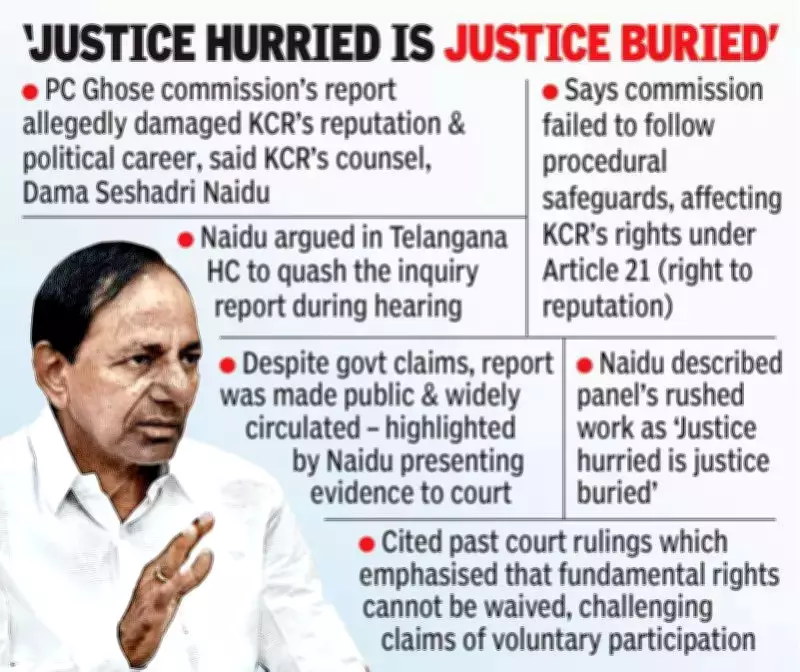
In a dramatic hearing at the Telangana High Court on Friday, counsel for former Chief Minister K Chandrasekhar Rao (KCR) launched a scathing attack on the PC Ghose commission, which investigated alleged irregularities in the Kaleshwaram project. Dama Seshadri Naidu, representing KCR, asserted that the commission's findings had "castigated, vilified and destroyed the reputation and political career" of a leader of KCR's stature, who had been "at the helm of affairs close to a decade."
Arguments Against Procedural Safeguards and Reputation Rights
Naidu presented his case before a bench comprising Chief Justice Aparesh Kumar Singh and Justice GM Mohiuddin, during proceedings on petitions filed by KCR and others seeking to quash the commission's inquiry report. He alleged that the commission failed to adhere to essential procedural safeguards, resulting in a "devastating and chilling effect" on KCR's reputation. Emphasizing the constitutional dimension, Naidu argued that this issue touches upon Article 21 of the Constitution, which protects a person's right to reputation—a right he deemed particularly crucial for politicians, whose primary qualification often lies in their public standing.
Allegations of Public Dissemination and Rushed Justice
Contradicting the Telangana government's claims, Naidu alleged that the commission's report was not only made public but also widely circulated, despite official denials of its release on public domains. He further criticized the commission's methodology, equating its rapid examination of voluminous records and submission of the report within a limited timeframe to the adage "Justice hurried is justice buried." This, he contended, undermined the integrity of the investigative process.

Challenges to Government Claims and Legal Precedents
Naidu challenged multiple assertions made by the state government. He cited past rulings from the Supreme Court and high courts to argue that fundamental rights, including the right to reputation, cannot be waived and that conduct should not obstruct their enforcement. Specifically, he disputed the government's claim that KCR participated voluntarily in the inquiry without submitting supporting documents, despite being given the opportunity. Additionally, Naidu contested the state's argument that the petition had become "infructuous" due to the investigation being handed over to the Central Bureau of Investigation (CBI), asserting that significant legal issues remained unresolved.
Critique of Commission's Procedures and Call for Fair Play
Referring to the notice issued by the commission to KCR, Naidu argued that even in trial courts, proceedings would not stand if adverse findings were not communicated to the accused. He described the commission's actions as a "calculated move," suggesting that although the report might be legally non-binding, it had orchestrated a "circus" to condemn KCR unheard and expose him without justification. Urging the court to intervene, Naidu called for preventing such "sinister play without a fair play," highlighting the need for judicial oversight to protect against reputational harm in high-stakes political inquiries.






