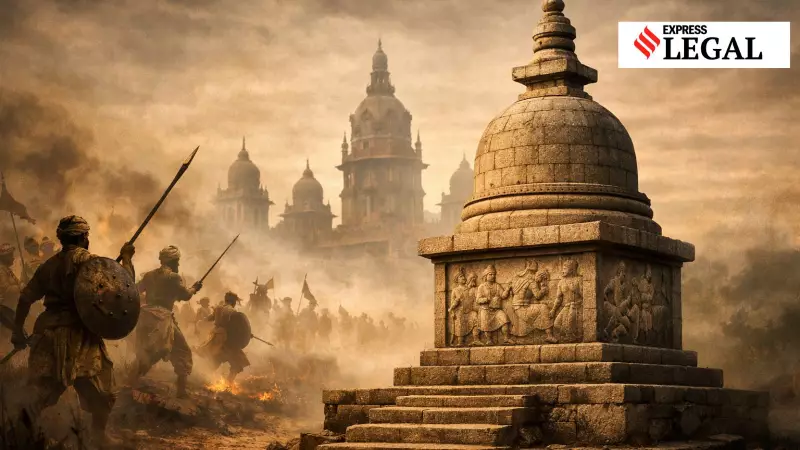
In a landmark judgment that connects 18th-century resistance with contemporary legal principles, the Madras High Court has granted permission for the installation of a memorial stupa to honour the warriors of the 1755 Natham Kanavai battle fought against the British East India Company.
Court's Rationale: From Stan Swamy to Historical Justice
The ruling was delivered by Justice G. R. Swaminathan while hearing a writ petition filed by advocate Siva Kalaimani Ambalam. The petitioner had approached the court after the local Tahsildar in Natham rejected his request to install the commemorative structure.
Justice Swaminathan drew a direct parallel to the memorial for Father Stan Swamy, the Jesuit priest and tribal rights activist who died in custody. "If for erecting a stone pillar in memory of Stan Swamy, permission is not required, certainly, no permission is required for erecting a stupa in memory of the Natham Kanavai battle," the court observed. This comparison anchored the judgment in a broader context of memorialising struggle and sacrifice.
Unearthing a Forgotten Victory: The 1755 Battle
The court placed on record the historical details of the conflict. The Natham Kanavai battle in 1755 was a bloody confrontation between the Melur Kallars and the British forces led by Colonel Alexander Heron. The Kallars emerged victorious in this engagement.
A significant trigger for the battle was the looting of brass idols from the Thirumogur (Koilkudi) Temple by British troops. The petitioner submitted that the Kallar community successfully retrieved these idols after their military success. The court noted that the Kallar community, with a martial tradition comparable to Gurkhas and Rajputs, was unjustly branded a "criminal tribe" by the British colonial administration.
Broader Philosophical and Constitutional Underpinnings
Justice Swaminathan's order elaborated on several key reasons for allowing the memorial:
India as a 'Salad Bowl': The court metaphorically described India not as a melting pot but as a "salad bowl"—a collection of distinct communities, languages, and regions. It held that the historical memories of these individual communities, like the Kallars, can be harnessed for higher national purposes, contributing to the nation's civilizational unity.
Celebrating Native Success: The judgment emphasized the need to "relish" and honour victories where Indian natives defeated colonial armies. It stated that such triumphs, achieved at great cost and against impossible odds, deserve celebration as they motivate and inspire transformation. The court intriguingly linked this to Chennai's status as India's chess capital, home to world champion Gukesh Dommaraju and others, stating that celebrating success begets more success.
Tamil Soil's Early Resistance: It was pointed out that after the British began ruling, resistance sprang up across the land. Some scholars argue the first war of Indian independence was waged not in 1857 but much earlier, and from Tamil soil. The court took judicial notice of formidable opponents the British faced in the Madurai region, including Velu Nachiyar, the Marudu brothers, Puli Thevar, Kattabomman, and Oomaithurai.
Constitutional Duty: The court invoked Article 51A of the Indian Constitution, which mandates every citizen's duty to cherish the noble ideals that inspired the national freedom struggle. Preserving the memory of such battles was seen as part of fulfilling this fundamental duty.
The Order and Its Implications
In its final order dated November 26, the High Court held that the petitioner lawyer is at liberty to erect the memorial stupa for the "Natham Kanawai War" on the petition-mentioned land. The judgment serves as a powerful reminder of the many localized, community-led struggles that formed the bedrock of India's long anti-colonial movement, often overshadowed by larger narratives.
By granting this permission, the Madras High Court has not only allowed for a physical memorial but has also endorsed the act of remembering and honouring diverse, subaltern histories that collectively define the nation's journey to freedom.