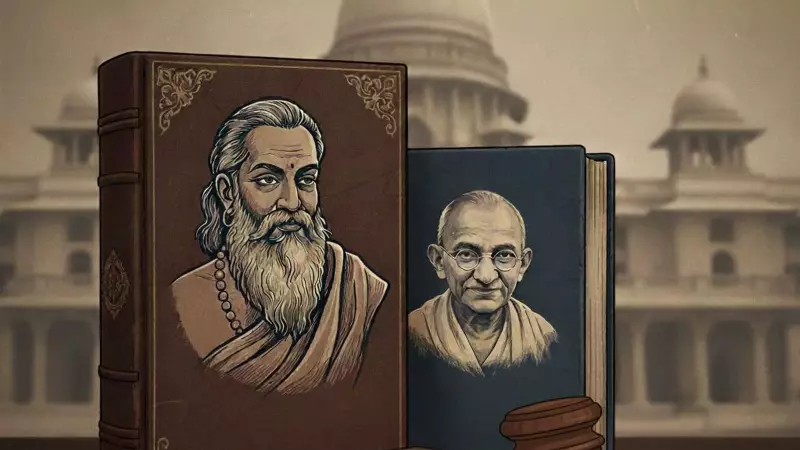
In a significant ruling that blends ancient wisdom with constitutional rights, the Madras High Court has quashed a First Information Report (FIR) filed against a group of villagers in Tamil Nadu for protesting against a state-run liquor outlet. Justice B Pugalendhi, while delivering the order, invoked the timeless warnings of Tamil poet-saint Thiruvalluvar and Mahatma Gandhi against the consumption of alcohol.
Court Invokes Ancient & Modern Voices Against Alcohol
The court emphasized that the dangers of alcohol were recognized centuries ago. Justice Pugalendhi pointed out that Thiruvalluvar dedicated a full chapter in the Thirukkural, composed over 2000 years ago, to advise against drinking. The order extensively quoted the poet's couplets, including one that equates a drunk person to someone who has consumed poison, and another poignant verse questioning how even a forgiving mother can bear to look at her son when he is inebriated.
"When even a mother who forgives all the faults of her son cannot bear to look at him when he is drunk, how can others be expected to tolerate him?" the court quoted from Thiruvalluvar's work.

The judgment also referenced Mahatma Gandhi, noting his stark observation that "Those who drink, ruin themselves and ruin their people." The court stated that alcohol strips individuals of decency and the capacity for useful work.
The Case: Peaceful Protest or Unlawful Assembly?
The legal issue stemmed from an incident in February 2025 in Ramanathapuram district. The local police had registered an FIR on a complaint from the Village Administration Officer (VAO) against ten petitioners and others. They were accused of forming an unlawful assembly in front of a Tamil Nadu State Marketing Corporation (TASMAC) shop, demanding its removal from their residential area.
The FIR included charges under various sections of the Bharatiya Nyaya Sanhita (BNS) and the Tamil Nadu Open Places (Prevention of Disfigurement) Act, 1959, such as wrongful restraint, unlawful assembly, and causing public nuisance.
Arguing for the petitioners, advocate K Yasar Arafath contended that the protest was entirely peaceful. He stressed that the TASMAC outlet's location in a residential area caused significant disturbance, especially to women and school children, and that there was no evidence of the petitioners causing public disorder.
The state, represented by government advocate P Kottaichamy, argued that the protesters had laid siege to the outlet without permission, thus creating a nuisance.
Constitutional Right to Protest & State's Duty to Health
Justice Pugalendhi's ruling delved deep into constitutional principles. The court underscored that India is a democratic welfare state, whose duty extends beyond maintaining law and order to ensuring the dignity, health, and economic security of its citizens.
The order cited Article 47 of the Constitution, which casts a duty on the state to improve public health and nutrition, and Article 21, which guarantees the right to life, inclusive of the right to a healthy life. "The duty of the state to protect and promote public health is of primary importance," the court observed.
It further affirmed that the fundamental right to peaceful assembly under Article 19 is a legitimate way for citizens to voice grievances against government policies. "It is the right of the society, whose health and family is devastated by the ill effects of liquor, to demand the closure of such liquor outlets," the judge stated. When such a demand is expressed peacefully, it does not constitute an offence.
The court acknowledged that while TASMAC is a major revenue generator for the government, this cannot override the devastating consequences of alcohol on public health and social fabric. Citizens directly affected by others' drinking have the right to question the establishment of such shops in their locality.
By quashing the FIR, the Madras High Court has powerfully reinforced the right to dissent against policies perceived as harmful, grounding its reasoning in both the nation's constitutional ethos and its rich cultural heritage that has long cautioned against the perils of alcohol.