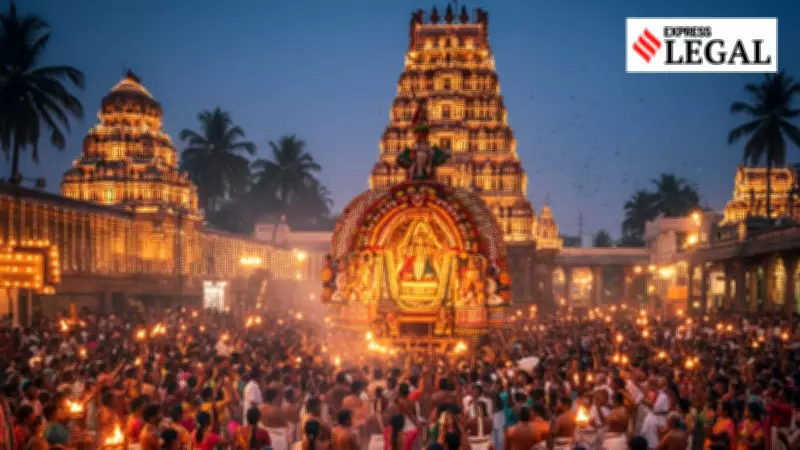
In a landmark ruling promoting religious equality, the Madras High Court has issued a directive to ban discrimination and ensure inclusive participation in temple festivals. The court specifically addressed the upcoming Kumbabishegam festival scheduled for February 8 at four temples in Melapanankadi village, Madurai.
Court's Firm Stand Against Discrimination
Justice S Srimathy of the Madras High Court delivered a significant order on February 2, emphasizing that religious celebrations must be conducted without any form of discrimination. The court explicitly stated that there shall be no "first honour" granted to any individual or community during the festival proceedings.
The judicial bench made it clear that the Kumbabishegam festival cannot be conducted by a single individual, particularly in a village setting where five distinct communities reside together. This ruling came during the hearing of a petition filed by Rathinam, a resident of Melapanankadi village, who sought directions for forming an inclusive committee for the festival.
Formation of Representative Committee
The court has directed the appointed fit person to establish a committee comprising one representative from each of the five communities residing in the village. This committee, working alongside the fit person, will be responsible for conducting the Kumbabishegam festival at the following temples:
- Arulmighu Ayyanar Temple
- Arulmighu Muniyandi Swamy Temple
- Arulmighu Karupasamy Temple
- Arulmighu Muthumariamman Temple
The fit person, a legal administrative appointee designated by the Hindu Religious and Charitable Endowments Department, had already been appointed on January 29 following a court order dated January 21. The current directive ensures this administrative arrangement translates into genuine community representation.
Background of the Legal Dispute
The legal controversy emerged when Rajeshkannan, another resident of Melapanankadi village, claimed exclusive rights to conduct the Kumbabishegam festival. This claim prompted Rathinam to approach the court seeking a mandamus to direct local authorities to form a committee representing multiple communities including Mutharayar, Maravar, and Adhi Dravidar communities.
The court's intervention comes at a crucial time, just days before the scheduled festival on February 8. The ruling emphasizes that temple honors and festival conduct cannot be treated as absolute individual rights, particularly when multiple communities have equal stakes in religious celebrations.
Broader Implications for Religious Practices
This judgment establishes an important precedent for religious celebrations across Tamil Nadu and potentially beyond. By mandating equal representation and banning discriminatory practices like "first honour," the Madras High Court has reinforced constitutional principles of equality in religious contexts.
The court has further directed that all relevant records pertaining to the festival be handed over to the newly formed committee and the fit person, ensuring transparency and proper documentation of the inclusive proceedings.
This ruling aligns with previous judicial observations that temple honors do not constitute absolute rights, and that religious institutions must operate in a manner that respects the dignity and participation rights of all community members.