

Maharashtra's 2017 Lift Act Remains Unenforced, Accidents Rise Amid Rule Delays
The Maharashtra Lifts, Escalators and Moving Walkways Act, 2017, continues to languish in a state of limbo, nine years after its passage, due to persistent delays in operationalizing its rules. This legislative inertia is unfolding against a backdrop of escalating lift-related accidents across the state, starkly highlighting critical gaps in inspection protocols and enforcement mechanisms, as emphasized by concerned citizens' groups.
Amendment Bill and Further Complications
The urgency of the situation has been amplified by the state government's recent introduction of the Lifts, Escalators and Moving Walks (Amendment) Bill, 2026. This proposed legislation aims to decentralize administrative powers. However, officials from Mantralaya have expressed apprehension, stating, "Any amendments in the Act will further delay the rules that are still to be cleared." This creates a paradoxical scenario where attempts to reform may inadvertently prolong the very implementation hurdles they seek to address.
Proposed Rules and Administrative Hurdles
The draft rules, which are essential for the Act's enforcement, outline several crucial provisions:

- Alignment with updated Bureau of Indian Standards (BIS) specifications.
- Implementation of modern fire evacuation protocols.
- Establishment of a 20-year operational life for lifts.
- Clear accountability for housing society office-bearers regarding maintenance through authorized annual contracts.
Despite their importance, these rules face significant bureaucratic obstacles. The law and judiciary department recently returned the draft for revisions, citing a lack of alignment with the parent Act. Furthermore, approval from the energy department remains pending. "The Act cannot be implemented without the rules," a senior Mantralaya official confirmed. Consequently, lift operations across Maharashtra are still governed by the archaic Bombay Lift Rules of 1958, which fail to address modern elevator systems, escalators, moving walkways, and contemporary safety standards.
Surge in Accidents and Inspection Failures
The regulatory vacuum is occurring alongside a disturbing rise in lift accidents, particularly in the Pune district. Recent tragic incidents include:
- A 12-year-old boy who died after being trapped between floors in Charholi.
- A lift crash involving six occupants in Wagholi.
- A child's hand caught in a lift door in Pimpri-Chinchwad.
Official data from the energy department reveals a stark increase, with fatal accidents rising to 12 in 2025-26 from none in the previous year. Experts attribute this alarming trend to a massive backlog of approximately 2.1 lakh lifts awaiting mandatory annual inspections, compounded by acute manpower shortages. Electrical inspectors, now burdened with multiple responsibilities, are prioritizing licensing and new approvals over routine safety checks.
"The system is reactive, not preventive. Inspections are the backbone of safety, and that's where the failure lies," stated a senior electrical safety expert, underscoring the systemic flaw.
Decentralization and Implementation Concerns
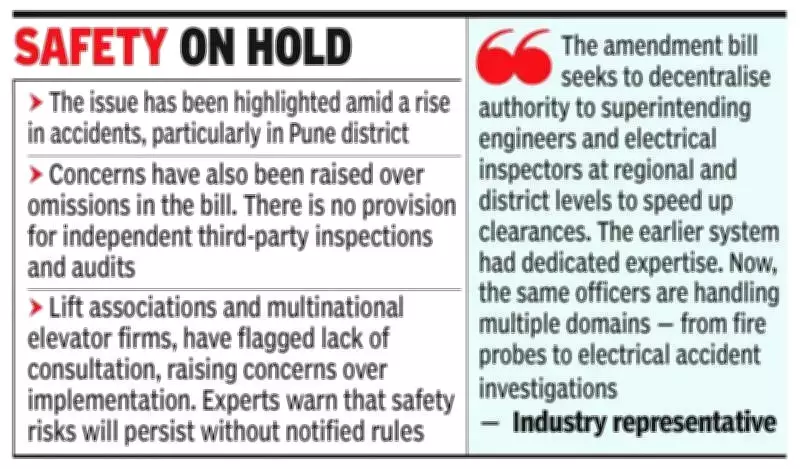
The 2026 amendment bill proposes to delegate authority to superintending engineers and electrical inspectors at regional and district levels to expedite clearances. However, industry representatives warn that this decentralization may dilute expertise. "The earlier system had dedicated expertise. Now, the same officers are handling multiple domains—from fire probes to electrical accident investigations. Lift safety inevitably suffers," noted an industry representative.

Furthermore, the bill has drawn criticism for significant omissions. Despite Chief Minister Devendra Fadnavis announcing plans for mandatory third-party audits similar to fire safety checks, the amendment currently lacks provisions for such independent inspections. Stakeholders, including lift associations and multinational elevator firms, have raised concerns over a lack of consultation, questioning the practical implementation of the proposed changes.
Persistent Risks and Calls for Action
A high-level committee has been established to define maintenance standards and manufacturer responsibilities. Yet, experts caution that without notified rules and a robust, functional inspection regime, safety risks will persist unabated. Consumer activist MN Rao issued a stark warning: "Continuing with outdated rules is a serious hazard with lakhs using lifts daily. The law exists, but is effectively on hold without rules and enforcement."
The situation presents a critical public safety challenge for Maharashtra, where legislative intent remains trapped in procedural delays, directly impacting the well-being of millions of daily lift users.





