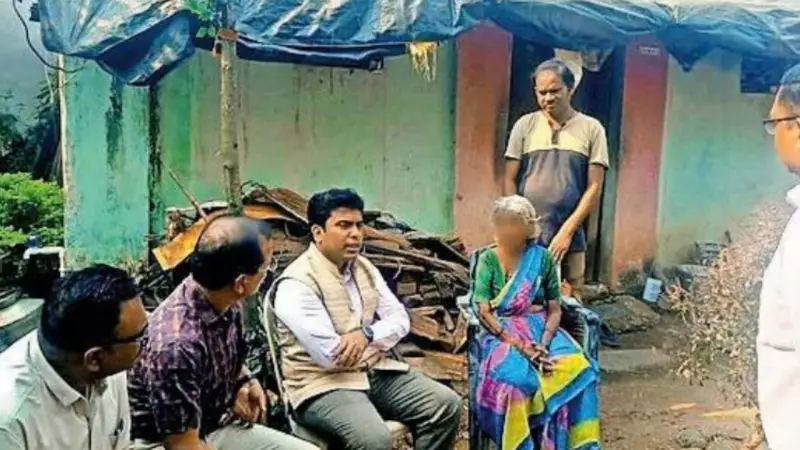
For decades, she was forgotten by the system her legal battle helped transform. Today, the elderly tribal woman known as "Mathura," whose 1972 rape case led to landmark changes in India's sexual assault laws, has finally received concrete assistance from the Maharashtra government. This follows a front-page report by the Times of India that revived national outrage over her neglected condition.
A Plea for Her Sons, Not Herself
When Chandrapur district collector Vinay Gowda visited her dilapidated hut in eastern Maharashtra, the 72-year-old survivor, undernourished and partially paralysed, asked for nothing for herself. Her sole request was help for her two sons to find stable employment. Collector Gowda assured her that the administration is actively exploring contractual jobs or business support for them.
"The younger of the two seemed proactive. We can think of helping him start a shop or a goat-rearing business," Gowda stated. During his visit on Tuesday, the collector handed over a cheque for Rs 8 lakh, which was immediately deposited in a bank account in her presence. The funds have been placed in a fixed deposit, requiring the tehsildar's approval for any withdrawal, and are expected to generate a monthly interest of approximately Rs 5,000 for her sustenance.

Immediate Government Response and Long-Term Support
The state's response was swift after the TOI report on November 30. Chief Minister Devendra Fadnavis immediately assured assistance. The Chandrapur district authorities were the first to act, pledging Rs 10 lakh—Rs 5 lakh from the district collector office employees' welfare fund and another Rs 5 lakh from CSR contributions by a local power plant.
In addition to the financial aid, the Maharashtra government has committed to providing her a new home. The house will be constructed under the Pradhan Mantri Awas Yojana (PMAY) at the very spot where her crumbling hut now stands, with the local gram panchayat tasked with the construction. An official has been specifically assigned to coordinate all her needs. Furthermore, Collector Gowda revealed that they are considering support for agricultural land under a tribal welfare scheme that can offer up to Rs 20 lakh for about 4 acres.
The Case That Changed India's Rape Laws
The woman's plight traces back to 1972, when she was raped by two policemen inside the Desaiganj police station. The subsequent legal battle, Tukaram vs State of Maharashtra, ended in a shocking acquittal by the Supreme Court in 1979. The verdict ignited nationwide protests and became a pivotal moment in Indian judicial history, leading to sweeping amendments in 1983 that made India's rape laws more stringent and victim-centric.
For years, the survivor of this landmark case lived in obscurity and poverty. The recent TOI report not only moved the state machinery but also drew attention from bankers, private-sector workers, film producers, Bollywood personalities, and US-based activists, many of whom planned visits to her remote village, located about 150 km from Nagpur.
Her story remains a stark reminder of systemic failures and the long road to justice, even as it now takes a turn towards dignity and support, decades later.