MP High Court Monitors Sealed Bhopal Slaughterhouse Amid Illegal Meat Scandal
A division bench of the Madhya Pradesh High Court, led by Chief Justice Sanjeev Sachdeva and including Justice Vinay Saraf, received crucial updates on Tuesday regarding the controversial Jinsi slaughterhouse in Bhopal. The Bhopal administration formally informed the court that the facility, operated by M/s Livestock Food Processor Pvt Ltd, has been sealed following a series of alarming discoveries.
Court Grants Liberty for Urgent Petitions
In its order, the court recorded the affidavit from the district administration and provided significant liberty to the petitioner organizations. Specifically, the bench stated that if the slaughterhouse reopens before the next scheduled hearing on March 16, the petitioners may approach the court for an urgent hearing. This move underscores the judiciary's proactive stance in addressing public concerns swiftly.
Origin of the Controversy
The slaughterhouse found itself at the center of a storm after members of a right-wing group allegedly intercepted a truck containing packets of banned meat. According to reports, the truck was loaded from the Jinsi facility, sparking immediate public outcry and legal action.

A Public Interest Litigation (PIL) was subsequently filed by Dayoday Mahasangh and two other organizations. The PIL highlighted that the slaughterhouse is illegally operated, contributing to atmospheric pollution and posing a severe threat to public health. These allegations brought the matter under judicial scrutiny, prompting a thorough investigation.
Pollution Control Board's Critical Recommendations
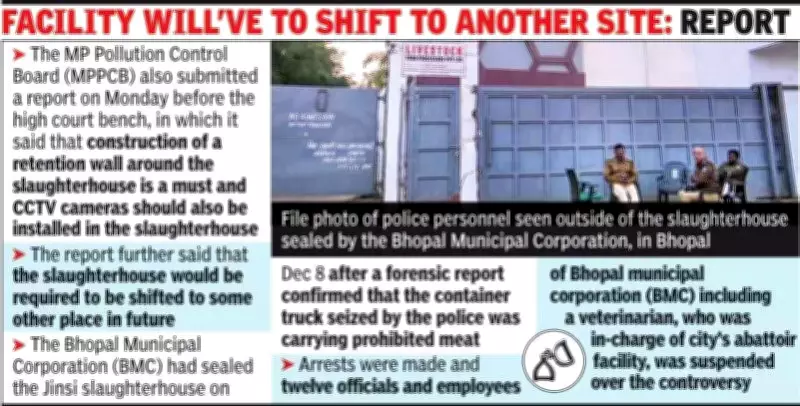
On Monday, the Madhya Pradesh Pollution Control Board (MPPCB) submitted a detailed report to the high court bench. The pollution watchdog outlined several mandatory measures, including the construction of a retention wall around the slaughterhouse and the installation of CCTV cameras for enhanced monitoring. Furthermore, the report indicated that relocating the slaughterhouse to another site in the future may be necessary to mitigate environmental and health risks.
In response, the court directed the operating company to comply with the MPPCB's recommendations. The order specified that if permissions from any authority are required for these actions, the company must apply promptly, and the concerned authority shall dispose of the application within two days of receipt, ensuring expedited processing.
Municipal Action and Forensic Confirmation
The Bhopal Municipal Corporation (BMC) took decisive action by sealing the Jinsi slaughterhouse on December 8. This step followed the receipt of a forensic report that confirmed the contents of a container truck seized by police. Activists had alleged that the consignment contained banned meat intended for transport outside the state.
Police sent samples from the seized meat packets to the forensic lab at Veterinary College in Mathura, Uttar Pradesh. The report, received on January 7, conclusively identified the meat as that of a cow or its progeny, which is prohibited under law. Following this confirmation, authorities arrested both the operator and the driver involved in the incident.
Ongoing Judicial Oversight
The court further emphasized that if any government authority undertakes the construction of the retention wall as recommended by the MPPCB, that authority must take immediate steps to ensure compliance with other recommendations from the Central Pollution Control Board (CPCB). This directive reinforces the court's commitment to enforcing environmental and public health standards rigorously.
As the case progresses, the MP High Court continues to monitor the situation closely, balancing legal procedures with urgent public welfare concerns. The sealing of the slaughterhouse marks a significant step in addressing illegal activities, but the court's ongoing involvement highlights the complexity of ensuring long-term compliance and safety.