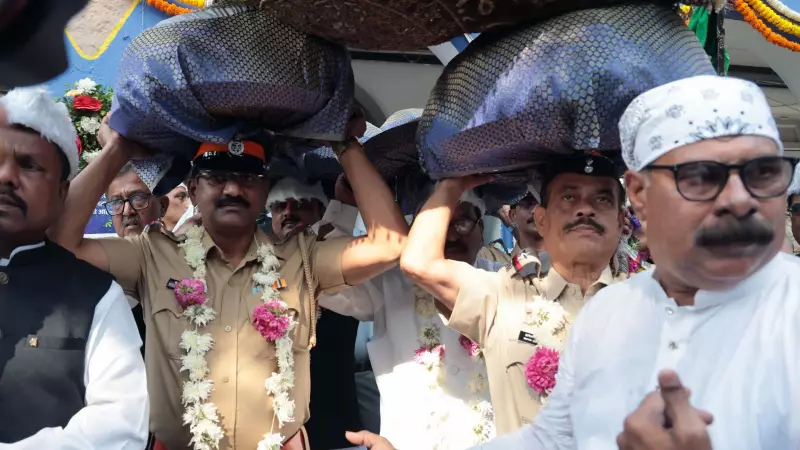
Every year, a distinctive procession unfolds on the streets of Mumbai. Led by a police band, uniformed officers march behind, with senior police officials carrying a green ceremonial cloth, or chadar, towards the ancient Mahim Dargah. This ritual, performed by a secular police force, is not a modern innovation but a tradition deeply woven into the city's history, stretching back to colonial Bombay and its distinctive relationship with Sufi saints.
The Historic Roots at Mahim Dargah
The Mahim Dargah of Hazrat Makhdoom Ali Mahimi stands as one of Mumbai's oldest Islamic shrines, with a history spanning over six centuries. Long before Mumbai became a megacity, this coastal shrine served as a spiritual anchor for sailors, traders, and communities along the western coast. The saint, of Arab descent, was a trained Islamic jurist who served as the faqih for Mahim's Muslim community until his death in 1431.
The Mumbai Police's connection to this shrine predates the modern police force itself. In the islands of Bombay, early lawkeeping was managed by the Bhandari Militia, an indigenous group. Their affinity for the dargah appears to have transitioned into the British era. While official records are sparse, local lore suggests early police posts, or chowkis, were situated near places associated with the saint, and some legends even speak of unseen aid in combating crime.
From Colonial Records to Modern Practice
The first documented evidence of police involvement comes from S M Edwardes, the Bombay Police Commissioner from 1909 to 1916. He meticulously recorded the annual Urs fair and the police procession, noting it as one of the three chief events. The Gazetteer of Bombay City and Island (1910) further details the ceremony, describing Sunni Muslim officers carrying trays and sepoys performing with long swords.
This tradition has not only survived but is formally institutionalized within the force today. A dedicated trust within the Mumbai Police oversees the annual offering, with personnel contributing Rs 25 per employee to fund the ceremonial items. The practice saw its modern pinnacle in October of this year, when the Mumbai Police Commissioner himself led the rituals at the Rahman Shah Baba Dargah in Dongri, offering the chadar on behalf of the entire force.
Beyond Mahim: The Dongri Connection
The bond extends beyond Mahim. A similar, enduring tradition exists at the Dargah of Haji Rehman Shah Baba in Dongri. The saint, a 19th-century wandering Sufi mendicant, is shrouded in local legends, including tales of the police being unable to detain him. While unverified, it is widely believed that the erstwhile Bombay Police began paying homage after his death in 1915, acknowledging his profound community influence.
Senior officers from the jurisdiction actively participate in the annual Sandal ceremony here, continuing a legacy of respect that bridges the colonial and post-Independence eras.
The Secular Logic Behind a Spiritual Ritual
The Mumbai Police's participation is less about religion and more a function of historical urban management. For decades, shrines like Mahim and Haji Ali were among the city's largest public venues, drawing massive crowds during annual Urs fairs. Policing these events—managing traffic, theft, and safety—required constant, ground-level coordination with shrine committees, gradually solidifying into ritual.
Geography played a key role. The old police chowkis at Mahim and Dongri were located adjacent to the dargahs, making local officers the first responders to any crisis. Furthermore, the British administration encouraged such gestures as a pragmatic strategy to maintain goodwill and prevent communal tensions in a volatile port city. After Independence, while most government departments shed colonial-era religious practices, these specific dargah traditions endured as unique cultural and civic artefacts of Mumbai's policing history.