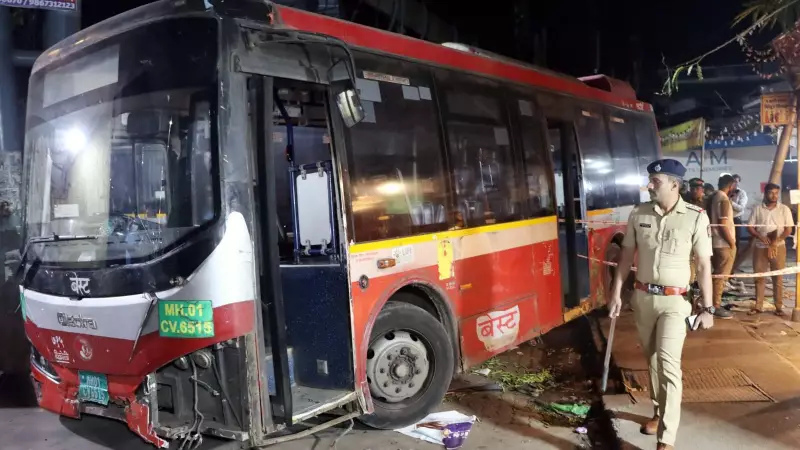
The recent BEST bus accident in Mumbai's Bhandup area, which claimed four lives, has brutally underscored a long-ignored civic peril: the chaotic and dangerous state of roads leading to the city's railway stations. This tragedy is not an isolated incident but a symptom of a systemic failure where extreme congestion, rampant encroachments, and administrative apathy create a perfect storm for disasters.
A Recurring Nightmare on Mumbai's Station Roads
While traffic snarls are a city-wide phenomenon, the conditions on "station roads"—the vital connectors between suburban hubs and railway stations—are uniquely hazardous. These arteries are perpetually choked by a volatile mix of hawkers, bus stops, depot vehicles, autorickshaw and shared-auto stands, and massive crowds disgorging from trains every few minutes.
The Bhandup accident on Monday, December 30, 2025, could have been far deadlier had the bus driver not swerved to the right, according to police. Local residents have long complained about the anarchy outside Bhandup station, where vehicles struggle to even turn due to the lack of space.

This pattern of neglect has fatal precedents. In June 2018, a reversing BEST bus outside Kurla railway station crushed 22-year-old Amrin Shaikh, who was trapped between two buses stationed at the depot. These incidents point to a chronic problem of poor planning and enforcement.
Hawkers, Jurisdiction Wars, and Failed Solutions
Railway activist Sameer Zaveri points to a deep-rooted issue: superficial action against hawkers, fueled by alleged bribes to local officials. "The government is aware about the passenger footfall at stations such as Kurla, Dadar and Thane. They have to ensure safe movement of passengers at the railway stations and outside," Zaveri asserted. He highlighted the common blame game between state authorities and the railways over jurisdiction, urging them to jointly find a solution.
The Brihanmumbai Municipal Corporation (BMC) faces its own challenges. A senior BMC official cited the absence of a functional Town Vending Committee, stalled by court matters, as a major hurdle. "Since there has been no survey, we do not know the names of actual legal and illegal hawkers making their removal a big challenge for us," the official admitted, explaining why encroachment removal drives offer only temporary relief.
Infrastructure solutions like skywalks have also fallen short, unable to handle the massive crowding, especially during peak hours. For pedestrians like Bhandup resident Datta Revankar, the experience is harrowing. "Forget going by a vehicle, even to walk out from Bhandup station and reach the main LBS road is a frustrating experience. Autorickshaws and buses are constantly honking and the footpaths are taken over by hawkers. It is disorienting," he said.
The Planning Gap and the Pedestrian's Peril
Urban planning experts reveal a significant gap in guidelines for designing roads outside high-density zones like railway stations. Vivek Pai, an urban planner who has worked on master plans for Thane and Kalyan stations, explained the process. "Indian Road Congress lays down specifications for types of roads. Besides these, we also carry out demand forecasting... to project the footfall and the load on a certain road before planning it," he said. For station roads, consultations are held with both railway and local authorities.
However, the theory crumbles on the ground. Both experts and residents agree that footpath encroachments have become the biggest impediment, forcing pedestrians onto the road where they must compete with vehicles for space. This dangerous mingling of pedestrian and vehicular traffic on clogged roads is a recipe for accidents.
The Bhandup tragedy is a grim reminder that Mumbai's station roads remain a critical urban flaw. It calls for more than piecemeal drives; it demands coordinated, long-term planning and stringent enforcement involving all civic agencies to prevent such loss of life from becoming a recurring headline.