

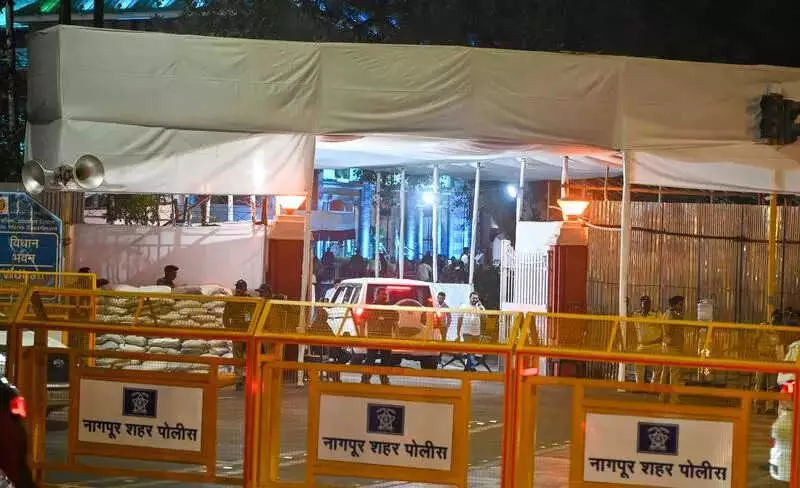
The city of Nagpur has been transformed into a high-security fortress as the winter session of the Maharashtra legislature commences on Monday, December 8. This unprecedented security mobilization follows specific intelligence inputs warning of potential retaliatory attacks by the Pakistan-based terror outfit Jaish-e-Mohammed (JeM), linked to India's Operation Sindoor conducted in May 2025.
Multi-Layered Security Blanket Activated
Authorities have implemented a rigorous, multi-agency security cover across the city. Critical locations including the Vidhan Bhavan, Ramgiri, and the RSS headquarters in Mahal are now under intense surveillance. The security apparatus involves a combination of NSG commandos, drone patrols, enforced no-fly zones, and advanced facial-recognition systems. A network of fortified checkpoints has been established to screen all movement.
An official stated that while there is no direct threat to the legislative session itself, precautions are extreme. "We have increased Bomb Detection and Disposal Squad (BDDS) checks at critical points. Security around the Rashtriya Swayamsevak Sangh (RSS) headquarters and several vital installations has been heightened," the official explained. Key religious sites like the Dr Hedgewar Smriti Mandir in Reshimbagh are also receiving enhanced protection.

Intelligence Warnings Prompt Vigilance
The alert stems from intelligence intercepts suggesting that JeM handlers, in response to Operation Sindoor's precision strikes on their Bahawalpur headquarters, may be planning attacks on crowded public places and RSS installations. The aim is suspected to be triggering communal unrest. The recent November 10 car-bomb blast near Delhi's Red Fort, which killed 15 people, has amplified these concerns, confirming a shift towards high-impact attacks within India.
Investigations into recent terror incidents point to infiltration routes through Nepal and Bihar, managed by Pakistan-based handlers. Consequently, surveillance has been tightened around members and former associates of banned organizations like the Students' Islamic Movement of India (SIMI).
City-Wide Deployment and Checks
For the session running from December 8 to 14, more than 5,000 police personnel, including State Reserve Police Force (SRPF) units, have been deployed. Security teams are conducting intensive checks at hotels, lodges, and guest houses. Transportation hubs like railway stations and interstate bus terminals are undergoing continuous screening.
Residences and hotels hosting ministers and political leaders are under strict access control with repeated anti-sabotage drills. Coordination between city police, the state Anti-Terrorism Squad (ATS), and central agencies is focused on securing all entry points, major temples, and crowded areas. Nationwide alerts have also been issued to secure vital installations, with bomb squads and quick response teams placed on standby.
The integration of AI-driven surveillance and close monitoring of CCTV networks in sensitive zones underscores the high-stakes security environment in Nagpur during this critical period.






