Nagpur High Court Clarifies Legal Standards for Mental Cruelty in Divorce Cases
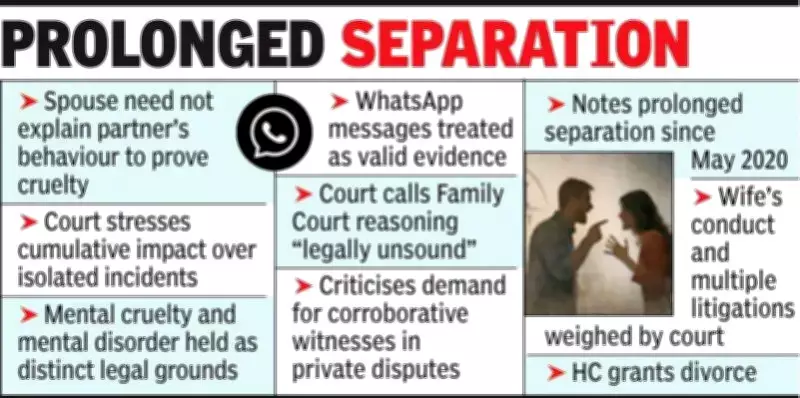
The Nagpur Bench of the Bombay High Court has delivered a significant judgment clarifying the legal framework surrounding allegations of mental cruelty in matrimonial disputes. In a landmark ruling last month, the court held that a spouse who approaches the court alleging mental cruelty is not required to explain or justify the reasons behind their partner's behavior.
Court Emphasizes Cumulative Impact Over Isolated Incidents
A division bench comprising Justices Mukulika Jawalkar and Nandesh Deshpande emphasized that claims of mental cruelty must be assessed based on the cumulative impact of conduct rather than isolated incidents. This approach marks a departure from more technical interpretations that have sometimes hindered genuine cases of marital distress.
The bench allowed an appeal filed by a husband and set aside a Family Court order that had denied him divorce. The marriage, solemnized in March 2019, was subsequently dissolved by the High Court's ruling.

Distinction Between Mental Cruelty and Mental Disorder
The court made a crucial distinction between mental cruelty and mental disorder as separate legal grounds for divorce. "The withdrawal of ground of unsoundness of mind does not defeat an otherwise independently established case of cruelty," the bench stated clearly.
This clarification came in response to the Family Court's earlier dismissal of the husband's petition, which had held that allegations were either unproven or linked to claims of mental disorder. The husband, represented by senior counsel Firdos Mirza and lawyer JB Gandhi, had chosen not to pursue the mental disorder ground but maintained his case for mental cruelty.
Evidentiary Value of Digital Communication
A key element in the case involved WhatsApp messages sent by the wife, including one expressing regret for her "irrational and uncontrollable behavior." The High Court held that such statements had significant evidentiary value, noting that "an admission by the party herself constitutes the best evidence in law."
The husband's original petition had alleged persistent erratic conduct by his wife, including public altercations, threats, abusive communication, and emotional distress that created an intolerable marital environment.
Criticism of Hyper-Technical Approach
The High Court bench criticized the Family Court for adopting what it described as a "hyper-technical approach," particularly in insisting on corroborative witnesses for incidents occurring within the privacy of matrimonial life. The court noted that most instances of cruelty occur within the confines of a house and may not always be supported by witnesses.
Describing the Family Court's reasoning as "legally unsound" and "fallacious," the High Court emphasized that the spouse alleging mental cruelty "is not required to justify or show reasons for the same being practised on him."
Practical Considerations and Final Order
The court noted that the wife was not residing in India and had not initiated proceedings for restitution of conjugal rights. While granting the divorce, the court stayed the operation of its order for four weeks to allow the wife to pursue any legal remedies available to her.
This judgment represents an important development in family law jurisprudence, providing clearer guidance on how courts should approach allegations of mental cruelty in matrimonial disputes and recognizing the practical realities of evidence collection in private marital settings.