

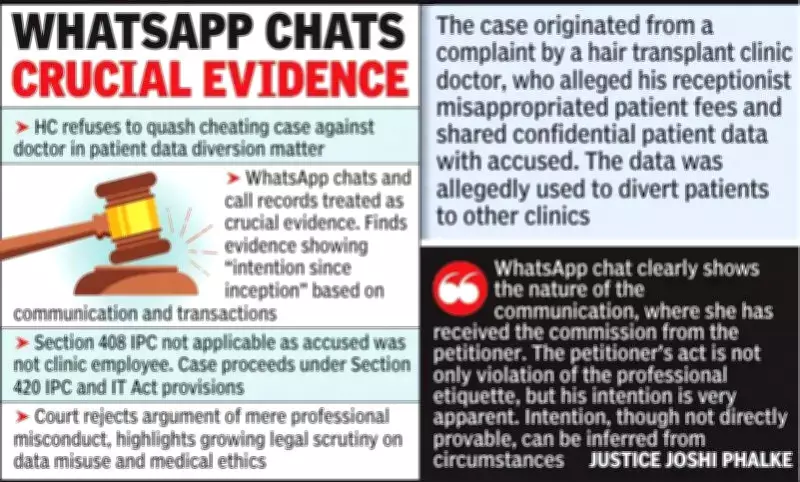
Nagpur High Court Upholds Criminal Proceedings Against Doctor in Patient Data Misuse Case
The Nagpur bench of the Bombay High Court has recently declined to quash criminal proceedings against a city-based doctor who is accused of obtaining confidential patient data through a clinic employee and diverting patients for monetary gain. The court ruled that the evidence on record indicates a prima facie case of cheating, warranting a full trial.
Court's Ruling and Ethical Emphasis
Justice Urmila Joshi Phalke rejected the doctor's plea to quash an FIR registered at Dhantoli police station. The charges include Section 420 of the Indian Penal Code for cheating and Section 66 of the Information Technology Act. In her judgment, Justice Phalke underscored the importance of ethical standards within the medical profession.
"There are moral principles which guide members of the medical profession in their dealings with each other. The basis of a good relationship between doctors lies in mutual respect and understanding," the court stated. It added, "a doctor must not wean away patients from his colleagues." This highlights the court's focus on professional integrity beyond mere legal violations.

Background of the Case
The case originated from a complaint filed by a hair transplant clinic doctor. He alleged that his receptionist misappropriated patient fees and shared confidential patient data with the accused doctor. This data was allegedly used to divert patients to other clinics for financial benefit.
Irregularities were discovered between February 14 and April 9, 2022, when certain patient entries were deleted, and fees totaling Rs 4,900 were not accounted for. During the investigation, the employee admitted to sharing patient information via WhatsApp and email.
Evidence and Court Observations
The investigation revealed sustained communication between the employee and the petitioner, supported by call detail records and mobile data. The court observed that WhatsApp chats clearly show the nature of the communication, where she received commissions from the petitioner. This evidence played a crucial role in establishing the case.
Rejecting the argument that the dispute was merely professional misconduct, Justice Phalke held that "the petitioner's act is not only misconduct or violation of professional etiquette, but his intention is apparent." She noted that intention, while not directly provable, can be inferred from circumstances such as repeated communication and financial transactions with the clerk.
Implications for the Medical Community
This judgment serves as a stern reminder to healthcare professionals about the legal and ethical boundaries in handling patient data. It reinforces that actions compromising patient confidentiality for personal gain can lead to serious criminal consequences, not just disciplinary measures.
The court's decision to proceed with the trial underscores the judiciary's commitment to upholding justice in cases involving data privacy and professional ethics, setting a precedent for similar incidents in the future.






