

The Nagpur bench of the Bombay High Court on Tuesday directed the Maharashtra government to pay Rs 50,000 each to two petitioners who were illegally handcuffed and detained by police in Amravati, holding that the act violated their fundamental rights under Article 21 of the Constitution.
Court's Observations on Police Conduct
A division bench comprising Justices Urmila Joshi Phalke and Nivedita Mehta partly allowed a writ petition filed by a practicing lawyer and an ex-serviceman, concluding that the police subjected them to "unwarranted humiliation and indignity" without any legal justification.
"The respondents — an inspector and a constable — acted as officials and exceeded their limits and thus committed an error in handcuffing undertrial prisoners. The duo subjected petitioners to unwarranted humiliation and indignity that cannot be done to any citizen and accordingly they are entitled to compensation," the judges said.

Background of the Case
The case arose from a 2010 incident at Talegaon police station, where cross-complaints between the petitioners and another individual were registered as non-cognizable offenses. Despite this, the petitioners were detained under preventive provisions and later taken in handcuffs through public places to the tehsildar's office, where they were granted bail. The petitioners challenged the police action through counsel Shriniwas Deshpande in the High Court.
The court noted there was no evidence to classify the petitioners as habitual offenders or hardened criminals, making the decision to handcuff them unjustifiable. It held that such actions directly contravened established Supreme Court guidelines, which restrict the use of handcuffs except in rare and exceptional circumstances.
Legal Precedents and Compensation
Relying on precedents, including Rudul Sah versus State of Bihar and D K Basu versus State of West Bengal, the bench underscored that compensation is an appropriate remedy for violation of fundamental rights. Quoting the principle, the court observed that monetary relief is "an effective and sometimes perhaps the only suitable remedy" for such infringements.
The judgment also referred to binding guidelines that prohibit routine handcuffing. "Handcuffs or other fetters shall not be forced on a prisoner, and police shall have no authority to direct the handcuffing," the court reiterated, emphasizing that any deviation must be backed by judicial approval.
State Liability and Disciplinary Action
While a departmental inquiry already found the policemen guilty and imposed penalties, the court ruled that compensation must be borne by the State. It rejected the argument that individual officers alone should be held financially liable, noting the officers acted in their official capacity.
"The state must repair the damage done by officers to the petitioner's rights," the court said, reinforcing the principle of state accountability in cases of custodial misconduct. The bench, however, declined to grant further relief sought by the petitioners, observing that disciplinary action against erring officials was complete.

Key Points of the Judgment
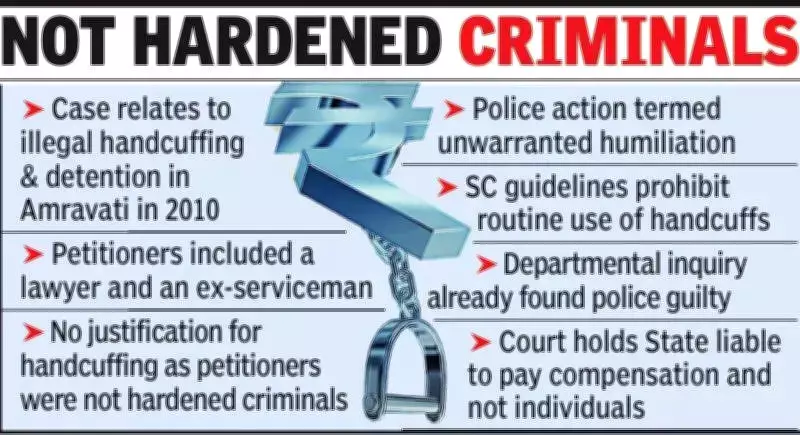
- Case relates to illegal handcuffing and detention in Amravati in 2010.
- Petitioners included a lawyer and an ex-serviceman.
- Court finds violation of Article 21 (right to life and liberty).
- Police action termed unwarranted humiliation.
- No justification for handcuffing as petitioners were not hardened criminals.
- Supreme Court guidelines prohibit routine use of handcuffs.
- Departmental inquiry already found police personnel guilty.
- Court holds State liable to pay compensation, not individuals.





