Nagpur Minor's Disappearance Exposes Police Inaction Despite Clear Legal Mandates
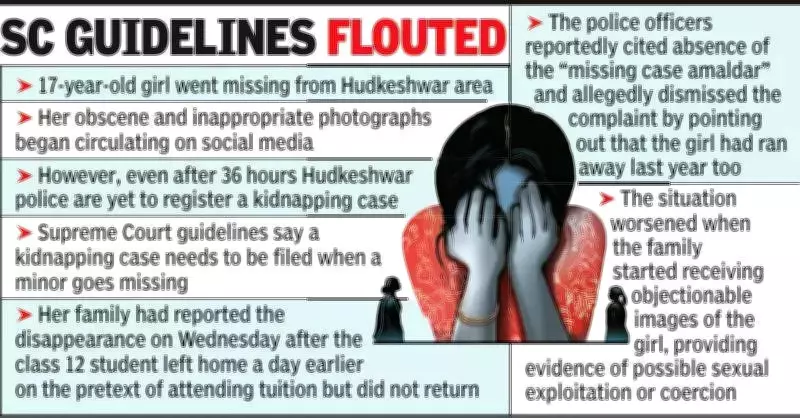
A deeply concerning case has emerged from Nagpur's Hudkeshwar area, where a 17-year-old girl has allegedly gone missing under suspicious circumstances. The situation has escalated dramatically with reports that obscene and inappropriate photographs of the minor have begun circulating on various social media platforms. Shockingly, even after 36 hours of the disappearance being reported, the Hudkeshwar police station had failed to register a formal kidnapping case, directly contravening established Supreme Court directives and national protocols designed to protect children.
Family's Desperate Search Meets Official Apathy
The family, consisting of parents who work as daily wage labourers, reported their daughter missing on Wednesday. The Class 12 student had left their Hudkeshwar home a day earlier, stating she was going to attend tuition classes, but never returned. Upon discovering her absence, the worried parents immediately began searching, contacting relatives and friends before finally approaching the Hudkeshwar police station on Wednesday evening.
Instead of swift action, the family reportedly faced dismissal. Police officers allegedly cited the absence of a specific "missing case amaldar" (officer) and pointed out that the girl had run away once before the previous year, using this past incident to downplay the current emergency. This response stands in stark contrast to legal requirements that treat every minor's disappearance as a potential kidnapping or trafficking case requiring immediate investigation.

Legal Framework Ignored as Evidence of Exploitation Emerges
The case took a more sinister turn when the family began receiving objectionable images of their daughter through digital channels. This development provides tangible evidence of possible sexual exploitation or coercion, triggering specific legal obligations under the Protection of Children from Sexual Offences (POCSO) Act, 2012.
An expert familiar with the case highlighted the multiple procedural failures: "Under the POCSO Act, the receipt and circulation of such material involving a child necessitates immediate registration of an FIR, urgent rescue efforts, mandatory medical examination upon recovery, production before the Child Welfare Committee (CWC), and immediate notification to the District Child Protection Officer (DCPO). None of these critical measures were initiated in this case."
District Child Protection Officer Mushtak Pathan emphasized the legal urgency, noting that Sections 19 and 21 of the POCSO Act demand swift action within 24 hours, including mandatory intimation to the district child protection unit. He warned that failure to rescue the minor or involve the CWC carries significant legal consequences for the officers responsible.
Pattern of Police Neglect in Hudkeshwar Emerges
Sources indicate this is not an isolated incident of alleged negligence at the Hudkeshwar police station. In a previous disturbing case, a woman who was a victim of fraud attempted to immolate herself at the Commissioner of Police Office after her grievances were completely ignored by the Hudkeshwar police. This pattern raises serious questions about the station's responsiveness to vulnerable complainants.
While Zonal DCP Rashmitha Rao confirmed that the matter concerning the missing minor is under inquiry and that the process for registering a kidnapping offence is underway, the significant delay remains a critical issue. The distraught mother made a heartfelt plea: "My daughter seems to have been forcibly held back. The police should rescue her immediately."
The case underscores a dangerous gap between national child protection standards and their ground-level implementation. Supreme Court guidelines and the Standard Operating Procedure (SOP) for missing children explicitly classify every minor's disappearance as a potential kidnapping, mandating immediate FIR registration without any 24-hour waiting period. The circulation of compromising images further escalates the legal imperatives for prompt action under the POCSO Act, making the police's initial inaction even more egregious and potentially unlawful.