Nagpur's Traffic Chaos: Pedestrians Face Daily Peril as Violations Soar
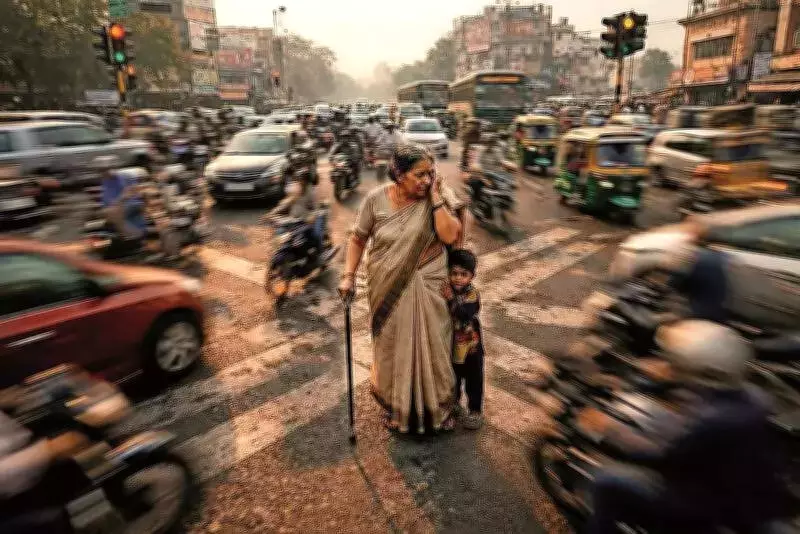
In Nagpur, the simple act of crossing a busy road or navigating a traffic junction has transformed into a high-stakes gamble for senior citizens and young children. The fundamental trust that a red signal will halt traffic is eroding rapidly on the city's chaotic intersections. For elderly residents and vulnerable pedestrians, every crossing demands sharp reflexes, precise timing, and, most distressingly, a heavy dose of luck.
A Grim Picture of Growing Road Indiscipline
Official data from the Nagpur traffic police paints a stark and troubling portrait of escalating road indiscipline. In the year 2025 alone, authorities penalized a staggering 48,286 motorists for jumping traffic signals. This translates to an average of 132 violators caught every single day. Compounding this danger, 16,333 speeding cases were recorded, meaning nearly 44 speedsters were apprehended daily.
These figures are further exacerbated by the perennial threats of wrong-side driving and a complete disregard for lane discipline. The cumulative effect of these menacing violations dramatically magnifies the risk for all road users, a reality that is starkly evident across Nagpur's thoroughfares.
Ground Reality at Key Junctions
Traffic experts acknowledge that the official numbers represent only a small fraction of the actual violators, with the real count being significantly higher. A firsthand visit to major junctions like Variety Square, Chhatrapati Square, Kriplani Square, Rahate Colony Square, Munje Chowk, and Kachipura Square validates this alarming data.
- Two-wheelers are frequently seen zipping past seconds after signals have turned red.
- Cars often stop beyond zebra crossings, blatantly blocking pedestrian pathways.
- Bikers aggressively zigzag between vehicles to save mere seconds, showing utter disregard for hesitant elderly pedestrians who are left feeling unsafe and anxious.
Voices from the Vulnerable
For 72-year-old Vikas Pethe, a resident of Narendra Nagar, crossing the road has become an intimidating ordeal. "Vehicles zoom past at such terrifying speeds that you can physically feel the vibration," he shared. "Even when the signal clearly turns red, someone always tries to sneak through. For someone of our age, a single hit could be a death sentence."
Another senior citizen, Anil Vaidya, highlighted the acute vulnerability of children. "When I take my granddaughter out, I hold her hand tightly. Young riders simply do not slow down. Many don't even wear helmets. They behave as if they own the road entirely," he lamented.
Alarming Violation Statistics
Helmetless riding remains one of the most rampant and dangerous violations. In 2025, nearly 6.95 lakh two-wheeler riders were challaned for this offense—an average of 1,900 daily. This accounted for a massive 63% of the total 10.92 lakh enforcement actions taken that year. Although this figure is lower than the 2024 spike of 8.92 lakh, it remains perilously high.
An analysis of year-wise trends reveals concerning patterns:
- Signal jumping cases were 62,356 in 2023, climbed to 64,514 in 2024, before dropping to 48,286 in 2025.
- Speeding cases declined from 22,246 in 2024 to 16,333 in 2025.
- However, wrong-side driving incidents rose sharply to 10,217 cases in 2025, reflecting a growing culture of impatience and a blatant disregard for basic traffic norms.
Calls for Stringent Enforcement and Awareness
Retired ACP (Traffic) Jameel Ahmed emphasized that enforcement must be both visible and consistent to curb this crisis. "A strong police presence at junctions, continuous patrolling, and sustained public awareness campaigns are critical," he stressed. "Parents must also actively intervene when youngsters treat public roads like personal racetracks."
While lakhs of violators are penalized annually, the daily averages tell a harsh and unrelenting story: traffic violations have become a disturbingly routine part of Nagpur's urban life. For a grandmother cautiously guiding her grandchild across a zebra crossing, a green pedestrian signal no longer offers reassurance. It has become a fragile hope—a silent plea that the approaching rider will choose responsibility over reckless speed.