Nagpur Launches Major Security Upgrade with Expanded CCTV Surveillance Network
The city of Nagpur is implementing a significant security enhancement initiative, with the Maharashtra government approving a substantial Rs 2 crore grant from the District Planning and Development Committee (DPDC). This funding is specifically allocated to dramatically expand closed-circuit television (CCTV) camera coverage in public areas surrounding two of the city's most sensitive and strategically important localities: Mahal and Reshimbagh.
Targeted Surveillance for High-Risk Zones
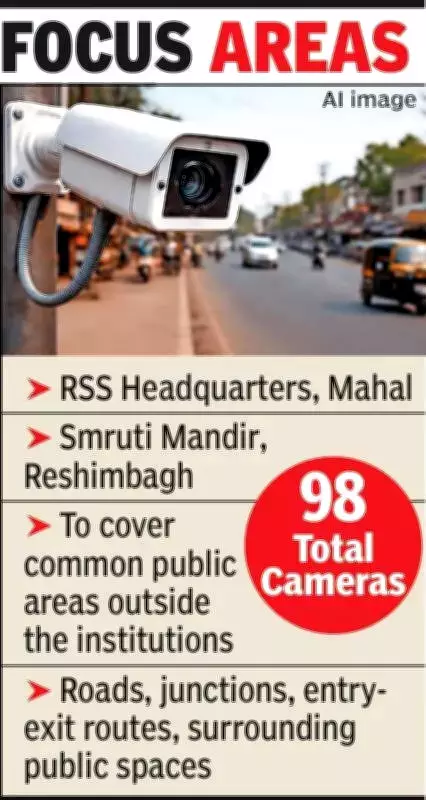
The primary focus of this security upgrade is on common public zones adjacent to major institutions. In Mahal, the area around the Rashtriya Swayamsevak Sangh (RSS) national headquarters will receive intensified monitoring. Similarly, in Reshimbagh, the vicinity of the historically significant Smruti Mandir will be covered. Authorities plan to install approximately 100 new high-definition CCTV cameras to effectively plug existing surveillance gaps and create a more comprehensive security grid.
"A joint inspection was conducted to identify vulnerable public spots that require greater monitoring," explained Additional Municipal Commissioner Vasumana Pant. "This includes busy intersections, pedestrian footpaths, and critical entry and exit points around these sensitive locations." The initiative is being executed by the Nagpur Smart and Sustainable City Development Corporation Limited (NSSCDCL) in close coordination with the Nagpur City Police.

Project Timeline and Technical Integration
Administrative approval for this crucial security project was secured before the Nagpur Municipal Corporation elections in December of last year. The tender process for execution has now been formally floated, marking the transition from planning to implementation. Officials have confirmed that the newly expanded surveillance grid will be seamlessly integrated with existing police control rooms.
This integration will provide law enforcement with real-time video feeds, enabling faster assessment of situations and supporting rapid response capabilities. The enhanced system is designed not only for live monitoring but also to serve as a valuable forensic tool for post-incident investigations.
Security Context and Threat Assessments
This security reinforcement comes at a critical time when Nagpur has been on heightened alert following national-level security advisories. Intelligence agencies have issued warnings about potential terror threats linked to extremist organizations, including Jaish-e-Mohammed (JeM). In response, sensitive sites across the city, particularly the RSS headquarters in Mahal and the Reshimbagh area, have been under intensified watch as part of broader citywide security measures implemented after recent counter-terror operations.
Community Response and Practical Benefits
Residents and local business owners in both Mahal and Reshimbagh have largely welcomed the surveillance expansion plan. Many believe that improved CCTV coverage in public areas will serve as a strong deterrent against various offenses, including petty crimes, acts of vandalism, and routine traffic violations. "Enhanced camera vigil will reassure the public and help police act faster when incidents occur," noted officials familiar with the development.
However, community members and some experts have emphasized that the system's effectiveness will depend heavily on consistent maintenance and around-the-clock monitoring, rather than merely the installation of new equipment. Police sources acknowledge that while broader security frameworks—including vehicle checkpoints (nakas) and regular patrols—continue to operate, a robust and modern surveillance network is increasingly crucial for both preventive policing and investigative support.
Additional Applications and Privacy Considerations
Beyond crime prevention, the expanded CCTV system is expected to support law enforcement in multiple capacities, including crowd management during large public events, religious festivals, and political gatherings. Civic activists and privacy advocates, while acknowledging the security benefits, have stressed the importance of implementing clear safeguards alongside the technological rollout.

These groups emphasize the need for established protocols governing data retention periods, authorized access to footage, and protection against potential misuse. They have also pointed to past concerns regarding non-functional CCTV units and coverage gaps in other parts of Nagpur, underlining that sustained upkeep and regular maintenance are essential for long-term effectiveness, rather than relying solely on periodic technological upgrades.
The Nagpur security enhancement project represents a significant investment in public safety infrastructure, aiming to create a more secure environment through technological integration while balancing surveillance capabilities with responsible data management practices.