

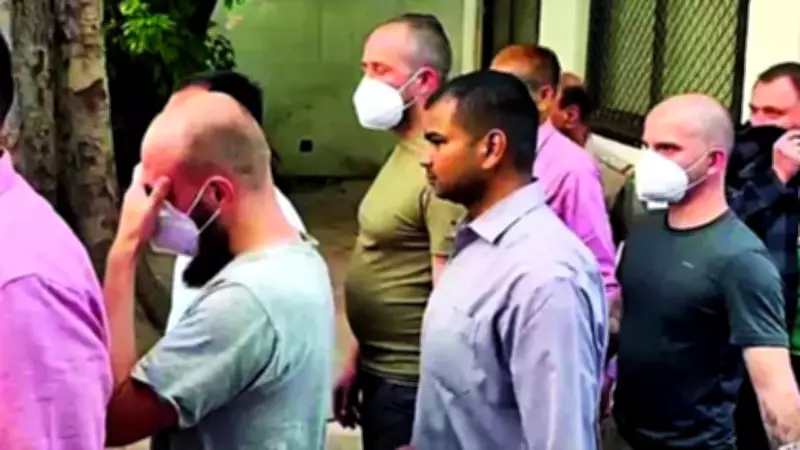
NIA Court Orders 30-Day Judicial Custody for Seven Foreign Nationals in UAPA Terror Case
A special National Investigation Agency (NIA) court in Delhi on Monday remanded seven foreign nationals to 30 days of judicial custody until May 6 in a significant terror case registered under the Unlawful Activities (Prevention) Act (UAPA). The accused include six Ukrainian citizens and one US national, marking a high-profile investigation into alleged international terror links.
Court Proceedings and Accused Details
Special Judge (NIA) Prashant Sharma issued the order after the seven individuals were physically produced before the court at Patiala House, following the completion of their 10-day NIA custody. The hearing was conducted in a closed courtroom, as reported by news agency ANI, underscoring the sensitive nature of the case.
The accused have been identified as US citizen Matthew Aaron Van Dyke and Ukrainian nationals Hurba Petro, Slyviak Taras, Ivan Sukmanovskyi, Stefankiv Marian, Honcharuk Maksim, and Kaminskyi Viktor. Van Dyke has filed an application seeking a virtual meeting with his family members, with the court issuing a notice to the NIA and scheduling a hearing on April 8. His legal representatives, Rohit Dandriyal and Rohit Gour, have also requested permission for a legal meeting, prompting the court to seek the agency's response.

Allegations and Legal Framework
The NIA has alleged that the accused were connected with ethnic armed groups in Myanmar and were providing support to certain proscribed Indian insurgent groups by supplying weapons, terrorist hardware, and training. The case has been registered under Section 18 (terror conspiracy) of the UAPA and relevant provisions of the Bharatiya Nyaya Sanhita (BNS).
On March 27, the NIA informed the court that fresh facts had emerged, revealing the accused persons' alleged involvement in a "conspiracy of terrorist act" under Section 18 of the UAPA. While earlier granting remand, the court noted that the FIR clearly indicates illegal acts against national security and India's interests, affirming the broad applicability of Section 18 of the UAPA.
Investigation and Key Questions
The agency has highlighted several critical aspects requiring further investigation, including:
- The reasons for the accused coming to India and traveling to Myanmar.
- Whether drones were used to impart training and the objectives behind their use.
- Potential direct or indirect links with Indian insurgent groups.
- The infrastructure utilized by the accused during their visits to India and beyond.
According to ANI, the judge emphasized that these questions are sensitive and necessitate thorough investigation, aligning with the NIA's stance based on case diary contents.
Background and Alleged Activities
The NIA alleges that 14 Ukrainians entered India on tourist visas at different times, traveled to Guwahati and then to Mizoram, and subsequently crossed illegally into Myanmar without proper documentation. Investigators claim they were scheduled to conduct training for Myanmar-based ethnic armed groups in areas such as drone warfare, operation, assembly, and jamming technology, allegedly targeting the Myanmar junta.
Furthermore, the agency asserts that the accused entered Mizoram, a protected area, before crossing into Myanmar, where they established contact with ethnic war groups. It is also alleged that they transported a large consignment of drones from Europe via India and were both trained in Myanmar and involved in training ethnic war groups linked to insurgent outfits in India.
Arrests and Locations
The seven arrested individuals include three Ukrainians detained in Delhi, three in Lucknow, and the US citizen apprehended from Kolkata, reflecting a coordinated effort across multiple cities in India.






