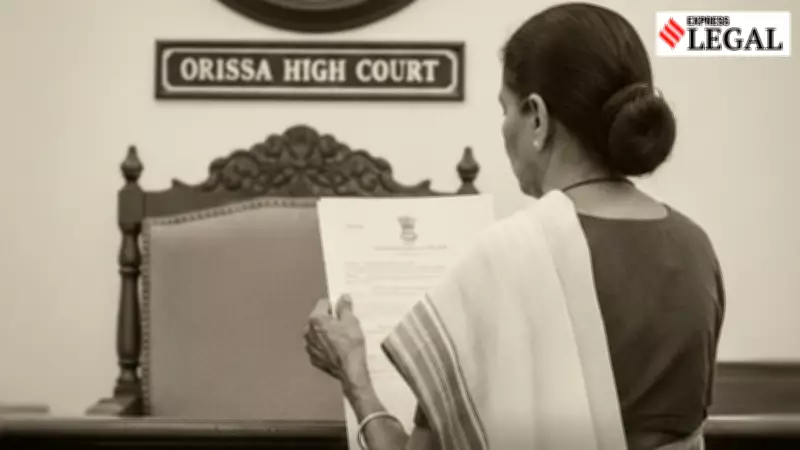
Three Decades of Legal Struggle Ends: Orissa High Court Grants Justice to RPF Constable's Widow
In a landmark judgment that brings closure to a three-decade-long legal battle, the Orissa High Court has directed the Indian Railways to pay Rs 4 lakh as compensation to the widow of a Railway Protection Force (RPF) constable who tragically lost his life while on duty in 1996. The court's ruling overturns a previous decision by the Railway Claims Tribunal that had denied compensation, marking a significant victory for the bereaved family.
Overturning the Tribunal's Denial
Justice Dr. Sanjeeb K Panigrahi of the Orissa High Court set aside the order passed by the Railway Claims Tribunal, which had dismissed the widow's plea on the grounds that the incident did not qualify as an untoward incident under the Railways Act, 1989. The Tribunal's reasoning was based on a narrow interpretation of the law, which the High Court found to be flawed and inconsistent with the legislative intent.
Understanding the 'Untoward Incident' Clause
The case hinged on the definition of untoward incident as outlined in Section 123(c) of the Railways Act, 1989. This section includes:

- Terrorist acts
- Violent attacks, robbery, or dacoity
- Rioting, shoot-outs, or arson in railway premises
- The accidental falling of any passenger from a train
Section 124-A of the same Act provides for compensation in cases of untoward incidents. The High Court emphasized that the explanation appended to this section explicitly includes railway servants on duty within the meaning of the term passenger for compensation purposes. This clarification was pivotal in the court's decision, as it broadened the scope beyond fare-paying travelers to encompass employees discharging official duties.
Key Findings and Legal Analysis
The material on record, including investigation and inquest reports, revealed that the constable slipped due to heavy rain in the railway yard and was struck by a moving train, resulting in his immediate death. The High Court noted that the Tribunal's conclusion—that the incident did not qualify as an untoward incident because the deceased was not traveling as a passenger—failed to account for the full scope of Section 124-A's explanation.
Furthermore, the Tribunal's attribution of negligence to the constable was deemed unsustainable. The court reiterated the settled legal position that mere negligence, in the absence of intention or mens rea, does not fall within the exceptions enumerated under the proviso to Section 124-A. This reinforced the widow's entitlement to compensation for her husband's untimely demise.
Background of the Case
The appellant's husband, serving as an RPF constable at Khurda Road Railway Station in 1996, met with the fatal accident during heavy rainfall. Initially, her plea before the Railway Claims Tribunal, Bhubaneswar Bench, was dismissed due to the alleged failure to produce a command certificate proving his duty status. After an appeal, the matter was remanded for reconsideration, but the Tribunal again dismissed it on the grounds of the incident not constituting an untoward incident.
The Orissa High Court's ruling not only provides financial relief to the widow but also sets a precedent for similar cases, ensuring that railway employees on duty are adequately protected under the law. This decision underscores the judiciary's role in interpreting statutes in a manner that upholds justice and fairness, especially in long-pending matters involving public servants.